Is thread count a marketing number, and what should you read instead?
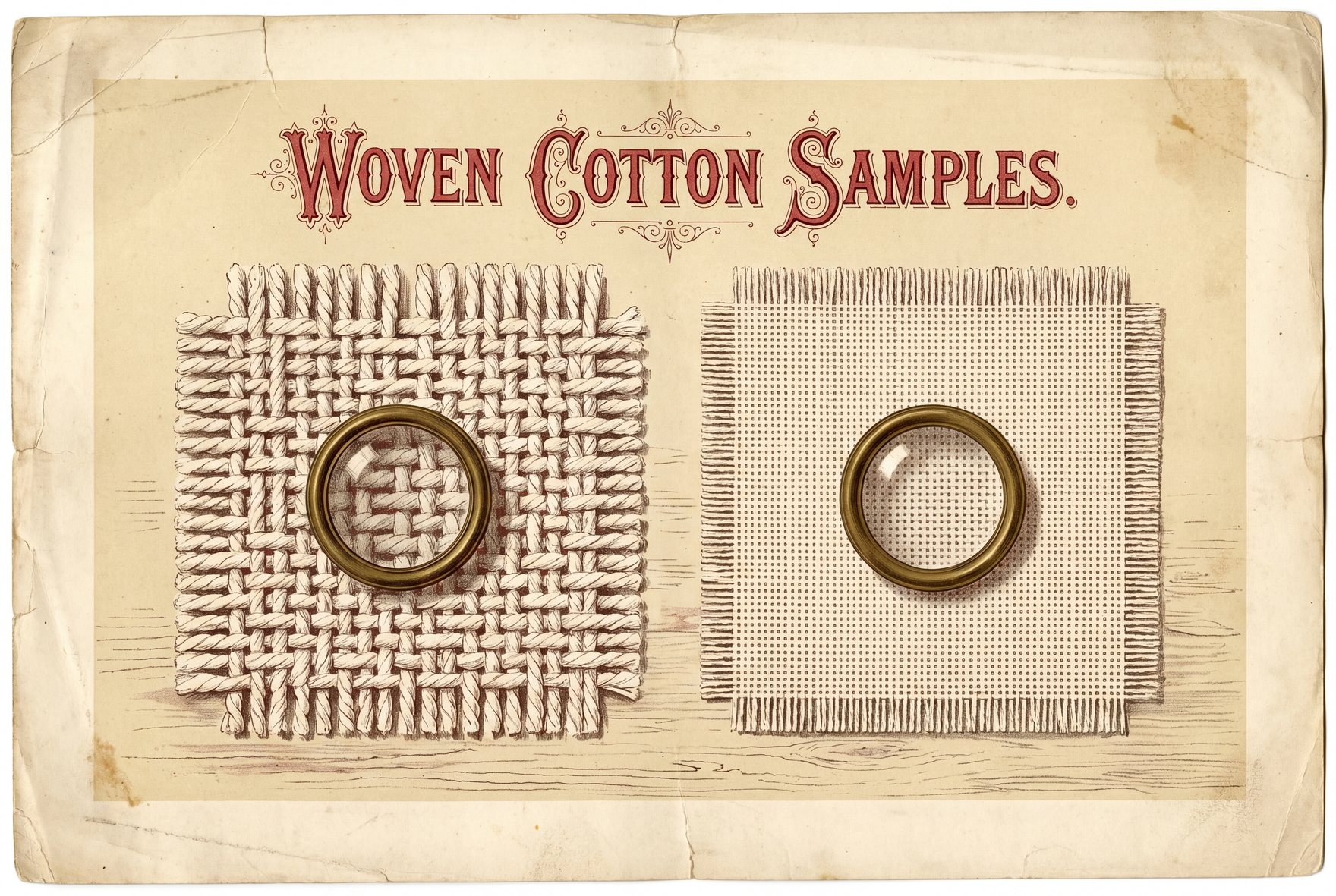
The biggest number you see on a sheet listing is usually the thread count. It is the easiest to inflate. This page shows you what the count measures, how sellers stretch it, and which facts on a listing tell you more.
Short answer: Thread count is the number of yarns in one square inch. Sellers can inflate it by counting each twisted strand. FTC staff said a sheet that is 300 thread count, two-ply should not be sold as 600 (Home Textiles Today). Consumer Reports' top-scoring percale had a count of only 280 (Consumer Reports). So you should read the fiber, the weave and the ply. Past about 400, those tell you more than the count.
This guide is for: people buying cotton sheets, mostly online, who see a four-figure thread count and want to know whether it is worth paying for.
Key Takeaways
Three points carry the whole page: how the count gets inflated, what a fair count looks like, and which label facts matter more. Each one carries a figure you can check against its source.
- A 300-count sheet woven from two-ply yarn is still a 300-count sheet. FTC staff said the fair label gives the count followed by the ply, and that such a sheet should not be sold to you as 600 (Home Textiles Today).
- Consumer Reports' top-scoring percale had a count of only 280. That set was strong and shrank little. Its textile expert called 400 the sweet spot and said spending on anything higher is not necessary (Consumer Reports).
- We read 10 product pages, and 3 of the 4 sets sold as 1,000-count never named the yarn's ply. Without the ply, you have no way to tell whether the count is fair. Every page that did name the ply said single-ply.
On This Page
Eight questions follow, in the order you would likely ask them, from what the number means to which range suits each weave.
You will find our count of seller pages in the fifth section. The tables in the fourth and last sections give our own judgement of which label claims hold up. No seller publishes that. Where this site has a fuller guide to a weave, the section links to it. If you only have a minute, read the short answer and the last table.
What does thread count measure on a sheet?
Thread count is the number of lengthwise and crosswise yarns in one square inch of woven fabric, added together into one figure.
Picture one square inch of sheet under a hand lens. Thread count adds the lengthwise yarns to the crosswise yarns inside that square. Weavers call them ends and picks. You only need to know that both directions get added together. The trade's test method, ASTM D3775, covers counting ends and picks in all types of woven fabric (ASTM International).
The definition stops there. The count describes density, not quality. A dense cloth can be woven from short, coarse fiber. A more open cloth can use long, fine fiber. It may feel better to you.
The count leaves out most of what you notice at night. It says nothing about the fiber or how finely the yarn was spun. It also skips the strands in each yarn and the finish on the cloth. Those details decide whether your sheet feels crisp or limp. They also decide whether it pills after a few months of washing.
You get a sheet that feels right and lasts when you read the count next to the other specs. Alone, the count tells you very little. Next to the fiber, the weave and the ply, it lets you check whether the figures fit together. A modest count in long-staple, single-ply cotton adds up, because long fibers spin into a smooth yarn that resists pilling. For you, that means a softer sheet that stays smooth wash after wash. A huge count with no other details gives you nothing to check. You pay for a number.
Why do some sheets claim a four-figure thread count?
Most very high counts come from counting each strand inside a twisted yarn separately, which multiplies the figure without adding cloth.
The inflation happens inside the yarn. Many sheet yarns are plied. That means two or more fine strands are twisted into one thread. Count each strand instead of each thread, and the figure doubles or triples. Your sheet stays exactly the same.
FTC staff looked at this practice. They said a fair label gives you the count first and the ply second (Home Textiles Today). You can find the staff letter in the FTC's list of advisory opinions (FTC).
A loom can only hold so much. A Consumer Reports textile expert said you just cannot fit enough threads on a loom for the four-figure counts now on sale (Consumer Reports).
The FTC position is guidance, not a rule. The opinion is not enforced, although the FTC Act still bans deceptive practices (Home Textiles Today). Sellers can print the bigger figure. In our count, most four-figure pages never named the ply. When you see a count that high, the checking falls to you. Look for the word "ply" first. Then you can weigh the price against what the page tells you.
Does a higher thread count make sheets better?
No, it does not. Tests of sheet sets found performance did not track thread count or price, and top scorers often sat well under the big numbers.
Consumer Reports tested sheet sets across a wide price range. It found a wide range of performance unrelated to price or thread count (Consumer Reports). Its testers found no correlation between claimed thread count and results. So you cannot shop by that number. One of its top-rated sets claimed a modest count.
An earlier Consumer Reports round agreed. The top-scoring percale had a modest count, yet it was strong and shrank little. It still fit deep mattresses after repeated washing and drying (Consumer Reports). A low count did not hold that sheet back.
More yarn in the square can also change how warm you feel. One seller's percale page says fabrics become warmer as thread counts rise. It says it chose a low count for the balance of softness and breathability (Saatva). A denser sheet can hold more heat against you.
A warmer sheet can suit you if you sleep cold. If you sleep hot, density is a poor reason to pay more. Either way, the count is silent here. It will not tell you how the sheet will behave on your bed. You learn that from the fiber and the weave.
What should you read on a sheet listing instead of thread count?
Read the fiber and staple, the weave, the yarn ply, and the fabric weight if it is given. Together they predict feel far better than one count.
You will find at least two of these facts on most listings. So you can usually check something.
| What to read | What it tells you | How easily a seller can stretch it (our judgement) |
|---|---|---|
| Fiber and staple, such as "extra-long staple" or "Pima" | Softness, strength, pilling | Moderate: easy to print, hard for you to check |
| Weave: percale or sateen | Crisp and cool, or smooth and warmer | Low: you can feel it on arrival |
| Yarn ply: single or two-ply | Whether the count is fair | High when missing: silence is the warning |
| Fabric weight, in grams per square meter | How much cloth there is | Low: it has a standard method |
| Thread count | How tightly the weave is packed | High: counting strands multiplies it |
You can confirm the weave with your own hands. Percale is woven one yarn over, one under. It feels crisp to you. Sateen floats more yarn on the surface. You will find it smoother and a little warmer. Our guides to percale sheets and sateen sheets cover each weave in detail.
A fabric weight, when you find one, is the most objective figure on the listing. An ASTM standard covers measuring fabric mass per unit area (ASTM International). Few cotton sheet listings give it. So treat it as a bonus. When you do see it, you know how much cotton you are paying for.
How often do sheet listings say whether the yarn is single-ply?
We read ten product pages and sorted them by what they said about ply. Six named it, three gave a count without it, and one gave no count.
We read 10 sheet-set product pages on September 26, 2026, using the page text our searches returned. We sorted each page by what it said about yarn ply. We searched for four-figure queen sets and for single-ply percale. So the sample leans toward the two ends of the market. This counts what sellers state. It does not verify any of it.
| What the page said about ply | Pages | The pages |
|---|---|---|
| Named the ply (all said single-ply) | 6 | four-figure sateen, percale set, combed cotton percale, organic percale, cool-touch percale, percale with yarn size stated |
| Gave a thread count but no ply | 3 | four-figure long-staple set, four-figure long-staple sateen, four-figure Egyptian cotton set |
| Gave no thread count at all | 1 | long-staple percale set |
The table lists every page by name, so you can check each one yourself. You can see two patterns. Every page that left out the ply advertised a four-figure count. Five of the six pages that named the ply gave modest counts. The sixth claimed a four-figure count in single-ply yarn. You could ask that seller for a lab report. Only one page gave a yarn size. None of the text we read gave a fabric weight.
In this small set, pages that named the ply tended to print modest counts. When the count was huge, the ply usually went missing. You can use that as a quick filter when you shop.
Does staple length matter more than thread count?
Usually, yes, it does. Longer cotton fibers spin into finer, stronger yarn with fewer loose ends, and that shows up in softness and pilling.
Longer fibers give you a sheet that feels softer and pills less. US rules set a minimum fiber length for cotton to count as extra-long staple (Federal Register). That cotton comes from the species Gossypium barbadense. Its strength and uniformity generally measure well above upland cotton. For you, that is the payoff. Your sheet feels smoother and holds up better through washing.
Why would you feel the difference? Longer fibers leave fewer loose ends sticking out of the yarn. Fewer ends mean a smoother surface. You also get less fuzz balling up into pills. Long fibers also let a mill spin finer yarn that still holds together. That is how your sheet can be soft without being thick.
Yarn fineness has its own number. One page in our count printed it. Within one fiber, such as cotton, a higher yarn number means a finer yarn (Handwoven). If a listing gives you this figure, it is telling you something real.
Consumer Reports advises you to focus on the fabric. It names combed, Egyptian or Pima cotton as the best choices (Consumer Reports). "Long-staple" on its own is vaguer than "extra-long staple." If you are paying extra, ask the seller which one they mean.
Can you trust "Egyptian cotton" on a sheet label?
You cannot trust the word alone. A large retailer pulled sheets sold as Egyptian cotton after finding its supplier had swapped in other cotton.
The fiber claim can be false even when the count looks precise. Target said its vendor Welspun substituted non-Egyptian cotton in some of its Fieldcrest Egyptian cotton sheets (Target). The switch ran for about two years. Those packages printed an exact thread count. The count did nothing to protect the people who bought them.
The industry answered with testing. The Cotton Egypt Association certifies fabrics as fully Egyptian and has long tested producers' fibers (Associations Now). It later announced a DNA testing program with a seal for makers who passed. For you, a seal like that beats the word alone. It is still not a guarantee. Target decided not to rely on the association's certifications going forward, according to a person familiar with its decisions (New Equipment Digest).
So what should you do with that? Treat "Egyptian cotton" as a claim to check, not a spec. Ask whether the fiber is certified. Keep your receipt, too. Then you can judge the sheet after a few washes. If it pills quickly or wears thin at the fitted corners, you have your answer, whatever the label said.
What thread count range makes sense for percale and sateen?
Honest single-ply percale lands in the low hundreds, and sateen runs a little higher. A count far above that deserves a question about ply.
There is no official ceiling. Still, the sources agree on a sensible band. Consumer Reports' textile expert put the sweet spot at 400. The expert said you need not spend on higher counts (Consumer Reports). The Sleep Foundation says a percale set with a count of 400 or higher is probably two-ply (Sleep Foundation). In our count, every single-ply percale page stated a count of a few hundred.
Sateen floats more yarn on its face. So you can believe a somewhat higher single-ply count there. Whatever the weave, if a figure sits far above that band, you should ask a question.
| What the page says | What it likely means (our judgement) | What to ask the seller |
|---|---|---|
| Percale in the low hundreds, single-ply | A plausible, fair count | Nothing about ply; check fiber and staple |
| Percale above 400, ply not stated | Probably two-ply yarn counted twice | "What is the ply?" |
| Four figures, ply not stated | Probably counted by strand | The ply, and how the count was tested |
| Four figures, "single-ply" | Unusual; would need very fine yarn | A lab report for the count |
| No thread count given | The seller leads with other specs | Fiber, staple, weave and weight |
If you like soft sheets, Consumer Reports suggests sateen, and percale if you prefer crisp. Choose the weave first. Then you can check that the count makes sense for it.
Common questions
Short answers to the follow-up questions people ask most once they stop trusting the big number on the front of the package.
Is a 1,000 thread count sheet better than a 400?
That number does not make it better. A four-figure count usually means plied strands were counted one by one. Consumer Reports found no correlation between claimed thread count and performance (Consumer Reports). Ask for the ply before you compare prices.
What does two-ply mean on a sheet?
Each thread is two fine strands twisted together. That is a fair way to build a sheet. The trouble starts when a seller counts both strands. That doubles the figure you see. A fair label gives you the count first and then the ply.
Is a 200 thread count sheet too rough?
It is not necessarily rough. A single-ply percale in the low hundreds can feel crisp and smooth if you choose long-staple cotton. You will notice the fiber and the weave more than the count. Wash it a few times before you decide.
Does thread count apply to linen sheets?
It hardly applies. Linen is usually judged by its weight and weave rather than a count. Sellers rarely lead with one. If you are weighing the two fabrics, our guide to linen versus percale sheets sets out the trade-offs.
How can you tell if sheets are single-ply?
Look for the words "single-ply" in the specs. If they are missing and the count is high, ask the seller in writing. On the pages we read, every seller that mentioned ply said single-ply. The silent ones all advertised four figures.
Should sateen have a higher thread count than percale?
It can run a little higher without any trick. Sateen puts more yarn on its surface. Consumer Reports' guide of about 400 still works as a check for both weaves. Above that, ask about ply before you pay more.