In brief
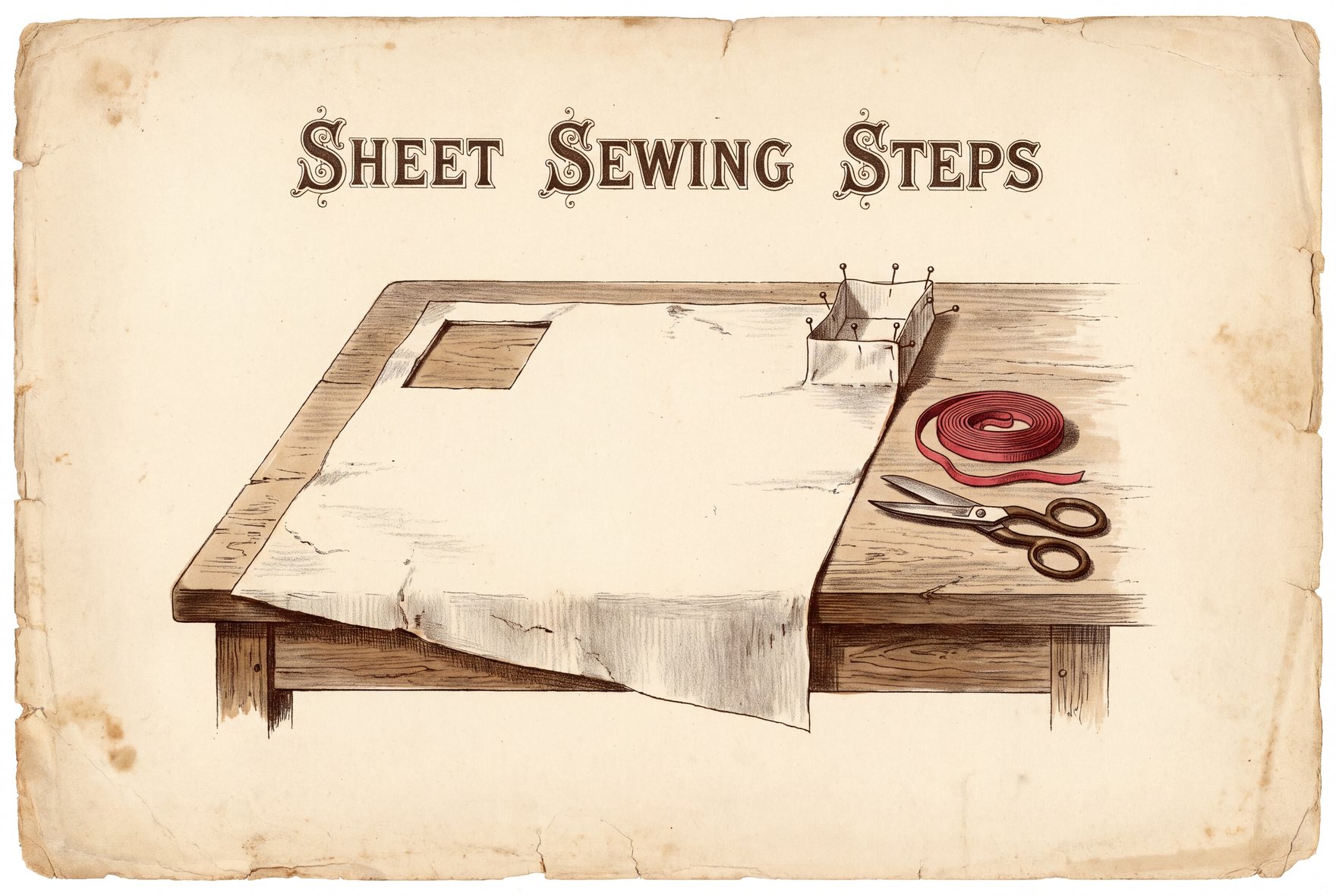
Measure your mattress depth first. Cut a square from each corner of the flat sheet equal to that depth plus 3 to 5 inches. Sew the two cut edges of each corner together into a box. Then sew elastic around each corner or along the whole edge, stretching it as you go. By our arithmetic, a same-size queen flat sheet leaves about 11 inches at each end. After a tuck, that suits a mattress about 7 inches deep.
This guide is for: people who sew at home and have a spare flat sheet, a mattress with no matching fitted sheet, and a sewing machine.
Key Takeaways
Three figures do most of the work here: the size of the corner square, the spare cloth in a flat sheet, and where tutorials put the elastic.
- Cut a corner square equal to your mattress depth plus 3 to 5 inches. The tutorials we read put the extra in that range, which leaves you room to tuck the cloth under and hem it.
- A same-size flat sheet leaves about 11 inches of spare cloth at each end. By our arithmetic on a published size chart, that covers a mattress about 7 inches deep once you allow for a tuck.
- 5 of the 11 tutorials we read put elastic at the corners only. Four run it around the whole edge, and two show both methods or use one strip across each end.
What parts make a fitted sheet stay on a mattress?
A fitted sheet is a flat panel with a box sewn into each corner and elastic in the edge that pulls the spare cloth under the mattress.
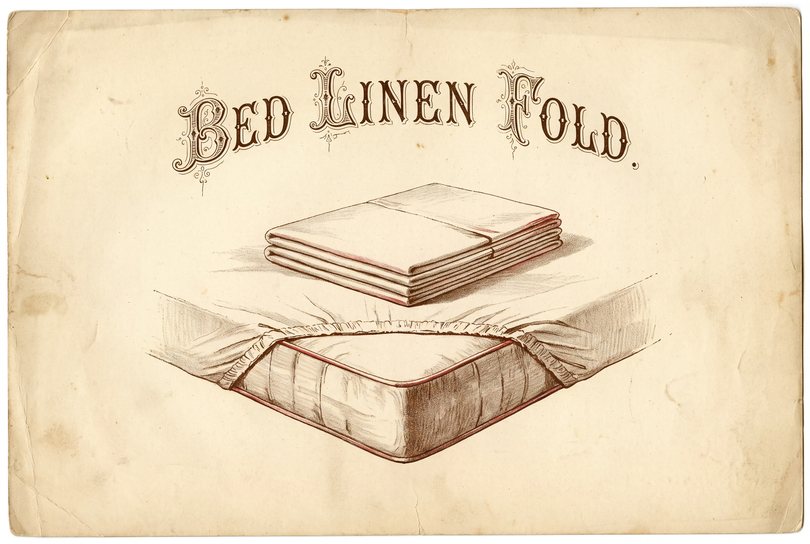
A fitted sheet has a few working parts. The top panel lies flat on the surface you sleep on. A boxed pocket at each corner holds a corner of the mattress. The elastic edge pulls spare cloth underneath. It keeps the sheet in shape when you turn over.
You can see the same layout in an older US patent for a fitted sheet (Google Patents). Each corner has a pocket made to receive a corner of the mattress. The elastic stretches as you fit it. Then it contracts and gathers the extra cloth under your mattress corner.
When you convert a flat sheet, you build those parts yourself. You cut a square from each corner. Then you sew the cut edges into a box and add elastic along the edge. You can usually keep the factory hems on any side you leave uncut. One tutorial skips hemming for that reason (Sewing Machines Plus). It sews the elastic straight onto the existing hem.
Are you unsure what each sheet does on a made bed? Our guide to the difference between a flat sheet and a fitted sheet covers that. This page sticks to the sewing.
How deep is the pocket on a fitted sheet?
Pocket depth is the height of mattress a fitted sheet can wrap, and sellers advise a pocket one to three inches deeper than the mattress.
Pocket depth is the side panel of the sheet. You measure it from the top edge of the mattress downward. US sellers print it as the third figure in a size. You read width by length by depth. Some sellers give the deepest mattress the sheet fits instead. One guide warns that people mix up the two labels. It says the pocket usually runs 2 to 3 inches deeper than the mattress it fits (RUHO Living).
| What the page states | Source |
|---|---|
| Queen fitted sheet, 60 × 80 × 15 in | Sleep Number product page |
| Queen fitted sheet, 60 × 80 × 18 in, fits a mattress up to 18 in | Direct Textile Store |
| Standard pocket 7 to 12 in; deep pocket from 13 in | RUHO Living |
When you sew your own sheet, you set the pocket depth as you cut the corner squares. So measure first. Run a tape from the top of the mattress to its bottom edge. Include any topper or pad. One size guide reminds you to do this (MattressVetted). If you skip the topper, your finished pocket will come up short. Write the figure down. Every cut you make depends on it.
Is a flat sheet big enough to make a fitted sheet?
A same-size flat sheet leaves about 11 inches of spare cloth at each end, enough for a thin mattress but short of what a deep one needs.
Not always. A flat sheet is wider and longer than the mattress. But the extra cloth is split between two sides, and the ends run out first. To check your own sheet, subtract the mattress width from the sheet width and halve the result. Do the same with the lengths. The smaller result is your spare cloth. It has to cover the side of the mattress, tuck under and take a hem.
The table runs that arithmetic on one published US size chart (American Textile). The last column takes off a tuck and a seam allowance at the sizes one tutorial uses (Sewing Machines Plus). These figures are our sums, so you will not find them on a seller's page.
| Bed | Flat sheet (in) | Fitted size on the same chart (in) | Spare at each side (in) | Spare at each end (in) | Deepest mattress with tuck and hem (in) |
|---|---|---|---|---|---|
| Twin | 66 × 96 | 39 × 75 | 13.5 | 10.5 | 6.5 |
| Full | 81 × 96 | 54 × 75 | 13.5 | 10.5 | 6.5 |
| Queen | 90 × 102 | 60 × 80 | 15 | 11 | 7 |
| King | 108 × 102 | 78 × 80 | 15 | 11 | 7 |
| Queen, king flat sheet turned sideways | 108 × 102 | 60 × 80 | 21 | 14 | 10 |
The pattern is plain. A same-size flat sheet suits a thin mattress. Think of a bunk or camper mattress. For a deeper mattress, you need a bigger sheet. Sizes also vary by seller. Measure the sheet you own before you cut. Our flat sheet size guide lists the usual sizes bed by bed.
How big a square do you cut from each corner?
Published tutorials size the corner square at the mattress depth plus about three to five inches, which covers the tuck and the hem.
The corner square sets the pocket depth. It is the one cut you cannot undo. The tutorials agree on the logic: the square equals the mattress depth plus a tuck and a hem allowance. They differ by an inch or two on the extra.
| Tutorial | Rule as published |
|---|---|
| Craftsy | Depth + 3 in |
| Sewing Machines Plus | Side + 3 to 4 in underneath + 1 in seam allowance |
| Diana Rambles | 10 to 15 in square by desired size; 7 in on an RV mattress |
| Crafting a Green World | Half the smaller of the spare width and spare length |
Wash and dry a new sheet before you measure it. Cotton can shrink in its first washes. Our guide to what repeated washing does to percale, sateen, and linen sheets explains why. Then trim the sheet so the spare cloth is even on every side. Lay it flat and smooth.
You can fold the sheet into quarters and cut all four corners at once. One tutorial does this with a square quilting ruler and a rotary cutter (Needlepointers). That way you get identical corners. Another marks the cutting lines with a washable fabric marker (Practical Mama). Measure the same distance along both edges from the corner. Measure twice before you cut. A square that is too big leaves you with a short pocket.
How do you sew the corner seams?
You fold each cut corner so its two edges meet, stitch them into a box, and then finish the raw edge so the seam does not fray in the wash.
Each cut corner now has two raw edges at a right angle. Bring them together with right sides facing. The corner folds into a box. Pin the edges, then stitch from the outer edge to the inner point of the cut. Craftsy lists the seam allowance it uses for this step (Craftsy).
Check the fit before you sew all four. Sew one corner and pull it over the matching corner of your mattress. Does the side panel reach underneath? If it falls short, the pocket is too shallow for this mattress. A larger flat sheet is the fix. You only lose one seam if you find that out now.
Next, finish the raw seam. A cut edge inside a sheet will fray in the wash unless you seal it. One tutorial runs a zigzag stitch over each corner seam to stop it unraveling (Sewing Machines Plus). Another uses a serger, a machine that trims the edge and wraps it in thread in one pass (Diana Rambles). A French seam also works if you want a neat inside. One tutorial shows you that seam step by step (Needlepointers).
Then deal with any edge you trimmed. Hem it or serge it before the elastic goes on. You can sew elastic straight onto edges that kept their factory hem.
Should the elastic go all the way around or only at the corners?
Both work. Corner elastic is quicker and uses less, while elastic around the whole edge gathers all four sides of the sheet under the mattress.
Sellers and inventors use both designs. One fitted sheet product page lists a fully elasticized edge along with elastic corner seams (Sleep Number). A US patent for a self-tucking sheet uses separate elastic pieces at the corners and ends instead (Google Patents).
Our count: on November 9, 2026, we read 11 published tutorials on turning a flat sheet into a fitted sheet. We sorted each one by where it tells you to put the elastic. The table records instructions only, and nobody here sewed a sheet to check them.
| Where the elastic goes | Tutorials | Pages |
|---|---|---|
| Corners only | 5 | Sewing Machines Plus, Practical Mama, Crafting a Green World, Craftsy, Mimzy & Company |
| Whole edge | 4 | Solomon Sewing, Diana Rambles, Needlepointers, The Dreamstress |
| Both methods shown, or one strip across each end | 2 | Kitschy Coo, Rise and Bake with Julie |
Corner elastic gives you the faster job. You sew a short piece at each corner, and the middle of each edge stays flat. Whole-edge elastic takes you longer. You stretch one long band around the full sheet. In return, it gathers every side. Is your mattress deep, or do the sides keep slipping? Then try the whole-edge method.
How much elastic does a fitted sheet need?
Tutorials give two rules: a short piece of about a foot at each corner, or one long band two thirds to three quarters of the mattress perimeter.
It depends on the method. With corner elastic, you cut a short piece for each corner and stretch it over a longer run of hem. Kitschy Coo cuts a piece about a foot long and pins its middle to the corner seam (Kitschy Coo). Each end is then stretched to a pin just under a foot from the corner. Mimzy & Company cuts a piece of the same length and stretches it fully as it sews (Mimzy & Company).
With whole-edge elastic, the band is shorter than the edge it gathers. Solomon Sewing adds the mattress length to its width, then scales up (Solomon Sewing). Its band is three quarters of the perimeter. The Dreamstress takes a fifth off the mattress circumference instead (The Dreamstress). Start with the shorter band. You can loosen it if the sheet fights you.
You will want narrow elastic. Several tutorials we read use quarter-inch elastic sewn on with a zigzag stitch. Keep the elastic stretched while you sew. Put the needle down whenever you stop, as Craftsy advises, so nothing slips (Craftsy). One tutorial stretches the elastic fully between pins as it stitches (Needlepointers).
Can you make a fitted crib sheet from a flat sheet?
The CPSC says to use only a fitted sheet made for crib use, so a sheet cut down from an adult flat sheet falls outside that advice.
Not if you follow the federal safety advice. The US Consumer Product Safety Commission (CPSC) tells parents to use only a fitted bottom sheet made for crib use (CPSC). A CPSC alert adds that a crib sheet should fit snugly and overlap the mattress (CPSC alert). Pulling on a corner should not dislodge it. The same alert says never use an adult sheet on a crib mattress, because it can come loose and tangle a young child.
A sheet you cut down from an adult flat sheet was not made for crib use. You chose its pocket depth and elastic at home. Nobody has checked them against a crib mattress. You can use the method on this page for adult beds and for older children who have moved out of a crib.
The CPSC page also asks for a firm, tight-fitting mattress, so a baby cannot get trapped between the mattress and the crib. Setting up a crib? Start with the mattress, then buy a fitted sheet sold for that mattress size. Make the bed, then pull each corner. If a corner lifts, the sheet does not fit and should come off.
Common questions
Short answers to the follow-up questions people ask once the main seams are sewn, from fabric choice to how long the job takes.
Can you make a fitted sheet without cutting the corners?
Yes. You can fold each corner into a triangle and stitch it on the inside. One reader suggests this because cut corners fray (Rise and Bake with Julie). Another tutorial pins each corner into a triangle, as if you were wrapping a present (DIY Joy). A patent for disposable fitted sheets forms its pockets by folding the edges and stitching diagonal lines (Google Patents).
Should you wash the flat sheet before you cut it?
Yes, if it is new. Craftsy advises washing new flat sheets before you cut (Craftsy). A sheet you cut before it shrinks can end up too small for your mattress.
What width of elastic do the tutorials use?
Narrow. Craftsy works with elastic under a quarter inch wide (Craftsy). Practical Mama uses quarter-inch elastic for its enclosed corners (Practical Mama).
How long does the job take?
With corner elastic, not long. One tutorial's title promises you the whole conversion in very little time (Crafting a Green World). Whole-edge elastic will take you longer.
Can you use a flat sheet that is bigger than your bed?
Yes, and a deep mattress often needs one. Craftsy calls for a flat sheet in your mattress size or bigger. If you turn a king flat sheet sideways, it gives a queen more cloth at each end. The size table above shows you how much.
Do you need to hem the sheet before adding elastic?
Only on the edges you cut. One tutorial trims just the top edge and serges that one (Diana Rambles). You can put elastic straight onto the factory hems.
Sources
Top Sheet's references for this piece, set out in citation order with the heading each one sits under.
- Google Patents (patents.google.com), sits under “What parts make a fitted sheet stay on a mattress?”.
- Sewing Machines Plus (sewingmachinesplus.com), sits under “What parts make a fitted sheet stay on a mattress?”; “Is a flat sheet big enough to make a fitted sheet?”; “How big a square do you cut from each corner?”; “How do you sew the corner seams?”; “Should the elastic go all the way around or only at the corners?”.
- RUHO Living (ruholiving.com), sits under “How deep is the pocket on a fitted sheet?”.
- Sleep Number product page (sleepnumber.com), sits under “How deep is the pocket on a fitted sheet?”; “Should the elastic go all the way around or only at the corners?”.
- Direct Textile Store (directtextilestore.com), sits under “How deep is the pocket on a fitted sheet?”.
- MattressVetted (mattressvetted.com), sits under “How deep is the pocket on a fitted sheet?”.
- American Textile (shop.americantextile.com), sits under “Is a flat sheet big enough to make a fitted sheet?”.
- Craftsy (craftsy.com), sits under “How big a square do you cut from each corner?”; “How do you sew the corner seams?”; “Should the elastic go all the way around or only at the corners?”; “How much elastic does a fitted sheet need?”; “Common questions”.
- Diana Rambles (dianarambles.com), sits under “How big a square do you cut from each corner?”; “How do you sew the corner seams?”; “Should the elastic go all the way around or only at the corners?”; “Common questions”.
- Crafting a Green World (craftingagreenworld.com), sits under “How big a square do you cut from each corner?”; “Should the elastic go all the way around or only at the corners?”; “Common questions”.
- Needlepointers (needlepointers.com), sits under “How big a square do you cut from each corner?”; “How do you sew the corner seams?”; “Should the elastic go all the way around or only at the corners?”; “How much elastic does a fitted sheet need?”.
- Practical Mama (practicalmama.com), sits under “How big a square do you cut from each corner?”; “Should the elastic go all the way around or only at the corners?”; “Common questions”.
- Google Patents (patents.google.com), sits under “Should the elastic go all the way around or only at the corners?”.
- Mimzy & Company (mimzyandcompany.com), sits under “Should the elastic go all the way around or only at the corners?”; “How much elastic does a fitted sheet need?”.
- Solomon Sewing (liamsolomonsmummy.blogspot.com), sits under “Should the elastic go all the way around or only at the corners?”; “How much elastic does a fitted sheet need?”.
- The Dreamstress (thedreamstress.com), sits under “Should the elastic go all the way around or only at the corners?”; “How much elastic does a fitted sheet need?”.
- Kitschy Coo (kitschycoo.blogspot.com), sits under “Should the elastic go all the way around or only at the corners?”; “How much elastic does a fitted sheet need?”.
- Rise and Bake with Julie (riseandbakewithjulie.com), sits under “Should the elastic go all the way around or only at the corners?”; “Common questions”.
- CPSC (cpsc.gov), sits under “Can you make a fitted crib sheet from a flat sheet?”.
- CPSC alert (cpsc.gov), sits under “Can you make a fitted crib sheet from a flat sheet?”.
- DIY Joy (diyjoy.com), sits under “Common questions”.
- Google Patents (patents.google.com), sits under “Common questions”.