What size flat sheet do you need, and what makes a good one?
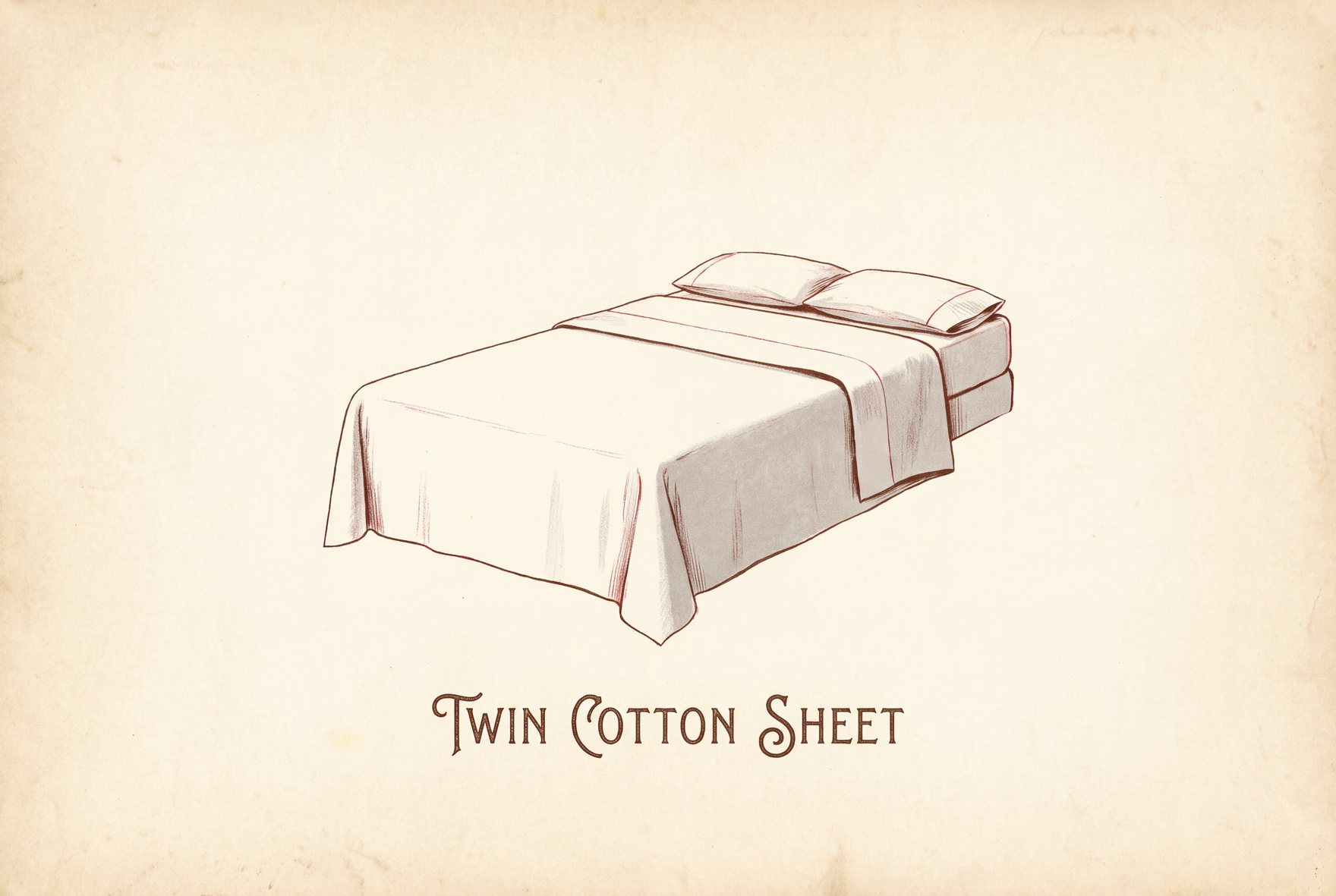
A flat sheet is the plain, hemmed piece of cloth that lies between you and your blanket. Most mistakes you can make when buying one come down to size, fiber and washing. This page covers each.
Short answer: In the US, a standard flat sheet is 66 by 96 inches for a twin, 81 by 96 for a full, 90 by 102 for a queen and 108 by 102 for a king. Those are the figures a seller publishes (The Company Store). Buy the size that matches your mattress, then check how deep the mattress is. Once it gets past about 13 inches, a standard sheet leaves nothing to tuck. Cotton is the easiest fiber to wash hot and keep white.
This guide is for: anyone in the US buying a flat sheet on its own or a full set, whether that's a twin flat sheet for a child's bed or a white cotton flat sheet to replace a worn one.
Key Takeaways
The points to keep if you read nothing else: the twin size, the side overhang limit, and the wash heat dust mites can't survive.
- A twin flat sheet is 66 by 96 inches on most US charts. Only four of the nine seller pages we read listed exactly that size.
- A standard flat sheet hangs 13.5 to 15 inches past each side of the mattress, so a mattress that deep uses up all the cloth.
- In a laundry study, no dust mites survived water at 131°F (55°C) or hotter. Check your care label first.
On This Page
Each entry below matches a section heading, in order, so you can scroll to the question you came here to answer about flat sheets.
What is a flat sheet, and is it the same as a top sheet?
Yes. A flat sheet and a top sheet are the same unfitted, hemmed piece of cloth that lies between you and your blanket or comforter.
You'll see both names used for the same product. Both names are right. Sellers use them side by side, and a listing labels its item "Flat (top) sheet only" (Amazon listing). The sheet has no elastic. The end with the wider hem goes at the head of the bed so you can fold it back over your blanket.
A flat sheet does double duty for you. It keeps skin oil and sweat off your blanket or duvet, which is harder to wash. It also gives you a light layer on warm nights. You can wash a flat sheet every week far more easily than a comforter.
You don't have to use one. Whether a top sheet earns a place on your bed is a separate question, covered in our guide on whether you need a top sheet. This page assumes you want one and need the right one.
Every flat sheet you buy here carries a label. Federal law requires that most textile and wool products have a label that lists the fiber content, the country of origin, and the identity of the manufacturer or another business responsible (FTC). That label is the first thing to read when sheets look alike. It tells you what you're buying. Leave the label on so you can check the care rules later. Cutting it off saves nothing.
What size flat sheet fits your bed?
Match the sheet to your mattress name, not its depth. A seller's chart below gives the flat and fitted sizes for every standard US bed.
The figures below are as a US seller lists them on its product page (The Company Store).
| Bed size | Flat sheet (width × length) | Fitted sheet, same seller |
|---|---|---|
| Twin | 66 × 96 in | 39 × 75 in |
| Twin XL | 66 × 96 in | 39 × 80 in |
| Full | 81 × 96 in | 54 × 75 in |
| Queen | 90 × 102 in | 60 × 80 in |
| King | 108 × 102 in | 78 × 80 in |
| California king | 108 × 102 in | 72 × 84 in |
Look at the king rows. King and California king share a flat sheet, because the sheet only covers the top and the mattresses differ by a few inches each way. Twin and twin XL often share a size too, which leaves the XL short at the foot. You can find a longer XL sheet on other pages, such as a retailer's size chart (Tuesday Morning) and a separate twin XL page from the same seller (The Company Store).
No law fixes the size you get. The ASTM specification for sheeting covers performance, and may be used by mutual agreement between the purchaser and the supplier (ASTM). So brands differ a little. The king chart is covered in our king size flat sheet guide.
Measure your mattress top before you order. Write down the width, the length and the depth. You'll need each figure when you compare charts. Keep the note on your phone for the next time you shop.
What size is a twin flat sheet?
Most US charts list the same twin flat size, cut wide enough to cover a twin mattress and tuck at the sides and foot. Some sellers go bigger.
The Sleep Foundation's size guide lists the width and length of a typical twin mattress (Sleep Foundation). Lay a standard twin sheet across it and you get more than a foot of cloth on each side. That covers the side of a normal mattress, with a little left over to tuck.
You get the same margin on length. The extra cloth has to cover the drop at the foot, the tuck, and the fold at your pillow. On a thin mattress, you'll have plenty. Twin sheets vary the most.
A seller offers an oversized twin flat sheet that runs both longer and wider (Amazon listing). L.L.Bean lists its twin flat as both wider and longer than the standard size (L.L.Bean). Some go much smaller. A marketplace twin listing gives a size barely wider than the mattress top (Walmart).
Check the listed inches, not the word "twin." On a bunk bed, a sheet that's too big bunches up and is hard to tuck into a tight frame. If your child kicks at night, a bigger sheet stays tucked longer. Pick for the bed you have. The size name alone won't tell you enough. For a daybed or trundle, measure the mattress and compare it with the chart before you buy.
Will a standard flat sheet tuck in on a deep mattress?
Often not. A standard sheet hangs a little over a foot past each side, so a mattress that deep uses it all and leaves nothing to tuck under.
No maker publishes this figure, so we worked it out from the seller chart above. The method is simple arithmetic. Take the flat sheet width, subtract the fitted sheet width, and halve the result. That gives you the cloth hanging past each side. Subtract your mattress depth to see what's left to tuck.
| Bed size | Overhang per side | Left to tuck, 10-inch mattress | Left to tuck, 14-inch mattress | Our judgement |
|---|---|---|---|---|
| Twin | 13.5 in | 3.5 in | None | Fine on a thin bed, short on a thick one |
| Full | 13.5 in | 3.5 in | None | Same limit as twin |
| Queen | 15 in | 5 in | 1 in | Tucks on most beds, tight on deep ones |
| King | 15 in | 5 in | 1 in | Same as queen |
Computed from the widths The Company Store lists. The mattress depths are examples, not measurements.
If your mattress is deeper than the overhang, or you add a topper, buy by the inches. An oversized sheet solves it. So does going up a size. Some people put a queen flat sheet on a full bed for this reason, and you can tuck the extra length deeper at the foot.
The same seller also lists a maximum mattress depth for its standard sheets. That figure is about the fitted pocket. Measure with your topper on. That's the depth your flat sheet has to cover each night.
What do seller pages say about twin flat sheet sizes?
We read the twin flat sheet pages of several US sellers. The standard size was the top answer, yet it appeared on fewer than half of them.
We read nine US seller pages offering a twin flat sheet on 2026-09-25 and counted what each one says about the flat sheet's size. We handled no sheets. The count covers only the text each page showed us.
- Stated exactly 66 × 96 inches: 4 pages.
- Stated a different twin size: 3 pages.
- Showed no flat sheet size in the text we read: 2 pages.
| Seller page | Twin flat size stated | Bucket |
|---|---|---|
| The Company Store | 66 × 96 in | Standard |
| Target Superity Linen | 66 × 96 in | Standard |
| Amazon WegaLinen listing | 66 × 96 in | Standard |
| Wayfair listing | 66 × 96 in | Standard |
| Amazon listing | 75 × 112 in | Different |
| L.L.Bean | 72 × 102 in | Different |
| Walmart listing | 47 × 90.5 in | Different |
| IKEA DVALA | Not shown | No size seen |
| Target Color Sense | Not shown | No size seen |
The "standard" size was the most common answer, but it showed up on fewer than half the pages. A twin label alone does not tell you the size. If you see no inches on a page, look for a size tab or ask the seller. The pages with no size may list it somewhere we didn't reach.
Is a cotton flat sheet worth choosing over polyester?
Usually, yes. Cotton handles hot washes and whitening well, and it builds up less oily gray film over time than polyester does.
Cotton is the fiber most people mean when they shop for a flat sheet. A bedding writer notes that materials like long-staple cotton or linen take longer to develop a gray detergent film than synthetic fabrics, because synthetics attract oil (Tom's Guide). You'll notice this most on a white sheet.
The downside you'll notice is that cotton shrinks. IKEA lists a maximum shrinkage figure for its cotton flat sheet (IKEA). Even a small percentage adds up on a long sheet. A sheet that barely fits when new may come up short later. Hot water can cause bedding items to shrink if they are made of cotton or other natural fibers (Sleep Foundation).
Read the fiber line on the label. The rules require the generic names and percentages by weight of the constituent fibers (eCFR). So you'll know when a sheet is a blend. A blend wrinkles less and dries faster. You may prefer that. If you want a sheet that looks crisp straight from the dryer, a blend is worth a look.
The weave shapes how the sheet feels in your hands. Percale is crisp and matte, and a seller says percale sheets naturally soften with washing. Our percale guide explains how to choose one. Thread count is worth a glance. Don't chase it. Feel the fabric in person when you can.
How do you keep a white flat sheet white?
Use less detergent, skip fabric softener, reach for oxygen bleach before chlorine, and dry the sheet in the sun when you can.
A white flat sheet goes gray or yellow for ordinary reasons. Too much leaves residue that makes sheets look gray and feel stiff, and softener coats cotton fibers with a waxy build-up that traps dirt and oils (American Blossom Linens). The oil from your skin does the rest.
Start with the dose. Measure your detergent instead of pouring freely. Using too much detergent or water that's too cold is the probable cause of streaks on laundry (Consumer Reports). Then leave the softener out.
When your sheet needs more help, try an oxygen bleach first. Consumer Reports calls it milder than chlorine bleach and fine for most cottons and blends. Chlorine can backfire. A writer found it reacts with mineral build-up to lock in hard-water film (Tom's Guide).
You can also use the sun. A few hours under the open sun can whiten and freshen bedding as well as a household dryer, if not better (Sleep Foundation). Hang the sheet out flat or over a line. Let the whole surface get light.
Check the label before you use any bleach, because instructions differ even on plain white cotton. IKEA's sheet says Do not bleach, while a cotton percale set says to use non-chlorine bleach if needed (Walmart listing). Follow the label on your own sheet. It's the maker's statement of what the fabric can take.
How often should you wash a flat sheet, and how hot?
Once a week is the common advice. In a laundry study, a hot wash killed the dust mites and a cold one left most alive. Check your label first.
The Sleep Foundation says We recommend washing your white sheets at least once per week (Sleep Foundation). The sheet touches your skin all night. It collects the same oil and sweat as the fitted sheet.
Heat is where you're most likely to go wrong. In a laundry study, hot water killed all the mites in the wash (PubMed). A cold wash did not remove most live mites. It still washed out most of the allergen in bedding dust, so cold water isn't wasted.
So you have a trade-off. Hot water clears mites and lifts dirt, but the Sleep Foundation warns it can shrink cotton and wear it out faster. If you have a dust mite allergy, the hot wash is worth the wear. If you don't, warm is a fair middle ground. Whichever you pick, wash the flat sheet with the fitted sheet. The set then wears evenly.
Check your machine and your label first. IKEA rates its cotton sheet for a warm machine wash and states a top temperature on its page (IKEA). Keeping a spare flat sheet in rotation makes weekly washing easy. You can have a spare in the wash while the other is on your bed.
Common questions
Quick answers on buying a flat sheet by itself, which way it goes on the bed, sizing up, twin XL fit and why a new sheet feels stiff.
Can you buy a flat sheet on its own?
Yes, and plenty of sellers offer that. A seller says the pieces are also sold separately for the same price as the set (The Company Store).
Which way does a flat sheet go on the bed?
Put the wide hem at the head, with the good side facing down. When you fold the top back over your blanket, the good side shows. Tuck the foot and sides first, then fold the head down. If both hems look alike, lay the sheet flat and compare them. The wider one goes up top.
Can a queen flat sheet go on a full bed?
Yes, if you want more cloth to tuck. By our arithmetic from the seller chart, you gain a few inches on each side. The extra length also lets you tuck deeper at the foot. Smooth out the bulk as you go.
Is a twin flat sheet the same as a twin XL flat sheet?
Often it is sold in the same size. A twin XL mattress is longer, though, so if your bed is an XL, look for a sheet listed at a longer length. Otherwise the foot pulls loose.
Does a flat sheet need to match the fitted sheet?
No. A seller pitches its separates as ideal for mixing and matching colors (Amazon listing).
Why does a new flat sheet feel stiff?
Crisp weaves start out firm. Percale softens with washing, and leaving out fabric softener helps too. Give a new sheet a few washes before you judge how it feels.