Should you buy linen sheets or percale sheets?
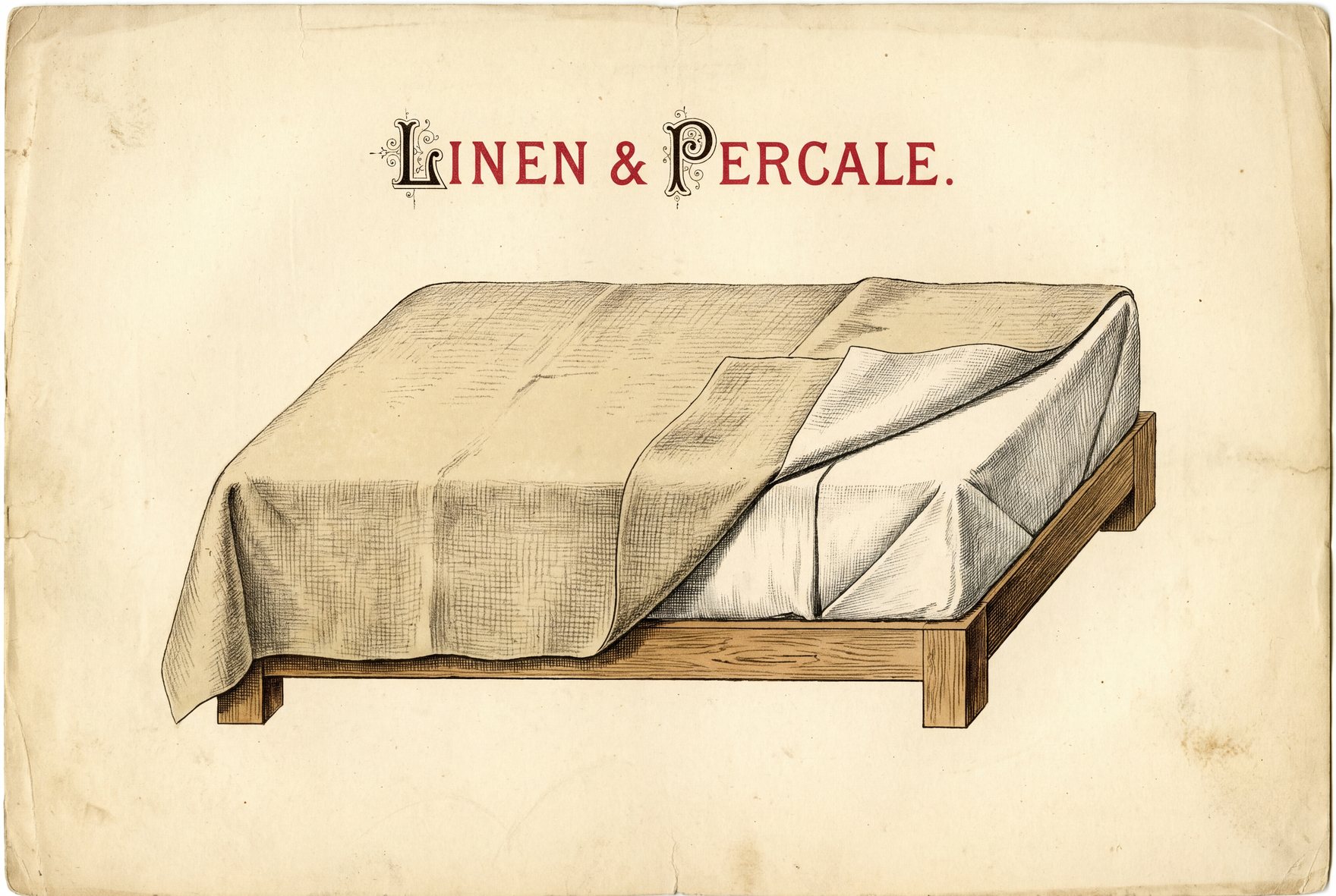
Linen sheets and percale sheets are not opposite choices. They are not even the same label. Sorting that out does most of your shopping for you. Linen is a fiber spun from flax. Percale is a plain weave, usually cotton. So the two labels answer different questions about the sheet in your hands.
Short answer: A linen sheet is flax, and a percale sheet is a tight plain weave, usually cotton. Both give you a cool, matte bed. Both are sold as the crisp alternative to sateen. Linen is heavier and more textured, and it wrinkles openly. Percale is smoother, thinner and cheaper. If your room runs warm and you never iron, buy linen. If you want the hotel feel, buy percale.
This guide is for: anyone comparing linen and percale sheet sets who wants to know which numbers on the label mean anything.
Key Takeaways
- Percale is a weave, not a grade. No law sets it, but one reference work puts the floor at about 180 threads per inch, and all four cotton sets we read cleared it.
- Linen is sold by weight, not by count. Six of the 10 linen listings we read printed grams per square meter, and no ply trick inflates that figure.
- Your sheet is a minor layer. Manikin testing of whole bedding systems ranged from 1.06 to 5.71 clo, and your sheet is not what moves that number.
On This Page
What are linen sheets, and how do they differ from percale?
Linen sheets are woven from flax fiber. Percale sheets are cotton in a tight plain weave, so you are comparing a fiber with a structure.
One reference work calls percale a closely woven plain-weave fabric used for bed covers, with a thread count of about 180 or higher, tighter than twill or sateen (Wikipedia). Our page on what percale means sets out the full definition. Most linen sheets use a plain weave too. So your real choice is flax against cotton, not one weave against another.
The two fibers do not behave alike. Compared with cotton, linen is stronger and a better heat conductor, though it is less elastic and creases easily (Materials, via PubMed Central). Creasing is the price you pay for the cool hand. Your skin gets a dry surface, and your bed looks slept in by morning.
Flax holds water well. One testing laboratory puts the moisture regain of flax at 12% (Testex). Cotton percale handles damp air competently. You tend to feel it sooner against your skin.
| Fabric | Structure | Number sellers quote | How fast it softens, our judgement | The usual complaint |
|---|---|---|---|---|
| Linen, stone-washed | Plain weave, flax | Grams per square meter | Fast | Visible creasing |
| Cotton percale | Plain weave, cotton | Threads per square inch | Slowly | Stiff at first |
| Cotton sateen | Float weave, cotton | Threads per square inch | Soft already | Warmer, snags |
If sheen is what you want instead, read our page on sateen sheets.
Does percale need a minimum thread count?
No law stops a seller from calling a loose cotton sheet percale. Reference works put the floor at about 180 threads per inch.
Regulators police honesty rather than definitions. Federal labeling rules make most textile products carry a label listing fiber content, country of origin, and the business responsible for the item (Federal Trade Commission). You can check the fiber. You cannot check the feel.
Thread count is where the number games start. An FTC enforcement official warned that inflating thread count by multiplying the real count by the number of plies could deceive shoppers about quality (Home Textiles Today). Ask for the count and the ply together. That pairing is the honest number. A seller with nothing to hide prints both for you.
There is a published way to settle an argument about count. ASTM has a test method for measuring end and pick count, and it applies to all types of woven fabrics (ASTM). Nobody hands you a pick glass. So treat any percale claim far above four hundred as marketing rather than construction. Our thread count guide walks you through the arithmetic.
Which sheet stays cooler, linen or percale?
Linen moves heat and moisture away from your skin quickly. The plain weave in percale keeps air moving, so both beat sateen on a warm night.
Flax has laboratory support behind the cooling claim. In comfort testing commissioned by the flax industry body, samples of linen, cotton, viscose and polyester went head to head. Linen allowed the most air flow through the fabric and was the most permeable to water vapor (Alliance for European Flax-Linen & Hemp). Commissioned research deserves a raised eyebrow. The direction still matches the physics, and it matches what you feel on a humid night.
Percale wins on geometry. Sateen floats each yarn over a run of threads before tucking it under, which exposes more yarn at the surface (The Good Sheet). That extra skin contact explains the smooth feel. It also explains the warmer bed. Percale has no floats to trap heat against you.
Both fabrics suit a warm room. You notice the difference most in humid weather. Linen wins on airflow and drying speed. Percale wins on smoothness at the same temperature. The gap between them is smaller than the gap between either one and a heavy sateen, so the weave matters more to you than the fiber argument suggests.
What does GSM tell you that thread count does not?
Thread count describes cotton. Weight in grams per square meter describes linen, and you cannot inflate weight by twisting yarns.
Flax yarns are thicker and less regular than combed cotton. Fewer of them fit in an inch. Sellers know it, and that is why linen listings quote weight instead. One maker's midweight sheet is a 190 gsm fabric, stone-washed for immediate softness (MagicLinen). Another states European flax linen, woven and sewn in Portugal (The Modern Dane).
Weight is a physical fact about the cloth. Someone cuts a sample and weighs it. No ply trick doubles the result. That makes it the most trustworthy number you will find on a linen label. It still tells you nothing about the flax itself, or about how the cloth was finished.
| Number on the label | What it describes | Can it be inflated? | Use it for |
|---|---|---|---|
| Threads per square inch | Cotton weave density | Yes, by counting plies | Comparing cotton to cotton |
| Grams per square meter | Weight of the cloth | No | Comparing linen to linen |
| Ply | Strands twisted per yarn | Stated or hidden | Judging a high count claim |
| Certificate number | Origin or chemical testing | Verifiable on a register | Checking a sourcing claim |
What did we find when we read the listings?
We read a set of seller listings. We counted which ones state a fabric weight, which state a thread count, and which state neither.
We read 14 seller listings for linen and percale bed sheets on September 20, 2026. We recorded what each page states in its own product description. We own no instruments and no samples. This is a count of published claims and nothing more.
Six linen listings gave a fabric weight in grams per square meter. Four linen listings named the flax origin or a chemical safety certificate and gave no weight. Four cotton percale listings gave a thread count and no fabric weight.
| Bucket | Listings | What the page states |
|---|---|---|
| Linen with a stated weight | Six | Flax origin plus grams per square meter |
| Linen without a stated weight | Four | Origin or certification only |
| Percale with a stated count | Four | Threads per square inch, no weight |
The phrase worth your attention is long-staple cotton. It predicts a sheet that still feels smooth next winter, because longer fibers leave fewer loose ends to work up to the surface. The face of the cloth stays flat wash after wash. One listing reads long-staple cotton percale at 270 TC (Brooklinen), and another prints the same count in long-staple organic cotton (Quince). Sellers converge on one figure. The count is a category convention rather than a point of difference. So compare the fiber wording and the price. You will feel the yarn every night. You will never think about the number again.
Is a European flax certificate worth paying for?
A flax certificate proves where the fiber grew and who processed it. It says nothing about how the finished sheet will feel on you.
The origin scheme has real paperwork behind it. Each certified company is audited yearly by an independent certifying body, and supplier invoices must show the certificate number and the composition of each certified product (Alliance for European Flax-Linen & Hemp). Certification is granted by Bureau Veritas for products containing a minimum of half linen, and only linen of certified European origin (Alliance). The audits cover the chain, not just the farm. The certifying body describes modular certification across all processing stages, from fiber to finished product, guaranteeing the European origin of the fiber (Bureau Veritas). A narrower mark covers the spinning and weaving stages inside Europe (Alliance).
Chemical safety marks are a separate thing again. They test the finished textile for restricted substances, and the certificate runs for a year before it has to be renewed (Hohenstein). You can check a claim yourself. Scan the code on the label, or type the certificate number into the scheme's label check tool (OEKO-TEX). Neither type of certificate grades softness, weight or durability. Buy one for what it is. That is a sourcing receipt, or a chemistry receipt.
How much do your sheets change how warm the bed feels?
Your duvet sets the warmth of your bed, along with how much of you it covers. The sheet is one thin layer inside a much bigger system.
Researchers put a heated manikin in a climate chamber. They measured whole bedding systems. Total thermal insulation ranged from 1.06 to 5.71 clo, depending on the posture, coverage, and materials (Waseda University). That spread is enormous. Your sheet is not the part that moves it.
Coverage does move it. The team ran 84 combinations of bedding and sleepwear, varying posture, clothing, quilt type and how much of the body stayed covered (Waseda University). Sticking a leg out changes more for you than changing fabric does.
Your sheet works on the thin layer of air at your skin. A dry, airy sheet keeps that layer comfortable for longer, but it will not rescue you from the wrong duvet.
How should you wash linen and percale sheets?
Wash cool, and dry low. Take the sheets out before they bake. Both fabrics last longer without bleach, fabric softener or a hot machine.
Sellers agree here more than they disagree. One tells you to machine wash with cool water and gentle detergent, skip bleach, tumble dry low and remove promptly (Baloo Living). Another warns that abrasive cleaners, non-natural detergent, bleach or fabric softener will shorten the lifespan of the product (Woven Kin Home). Both pages land on one list for you. Cool water, mild detergent, low heat, and nothing harsher than that in the drum.
Most linen sheets now arrive softened already. One listing describes its fabric as pre-washed and pre-shrunk, arriving ready to use (MagicLinen). That matters to you, because unfinished flax shrinks on its first hot wash and never comes back.
Percale asks one extra habit of you. Pull it out of the dryer while it is barely damp, then smooth it onto the bed. Heat sets creases in cotton, and a percale sheet dried to a crisp stays wrinkled until you wash it again. Linen does not care. You were never going to win that fight. Our notes on washing sheets cover detergent and water temperature in more detail.
So which should you buy?
Match the fabric to your room, your laundry habits and your patience with wrinkles. Price sorts itself out once those are settled.
Choose linen if your bedroom runs warm. Choose it if you line-dry, or if a rumpled bed reads as relaxed to you. Choose percale if you want a smooth, flat, hotel-like surface, if you iron, or if you would rather spend less for a similar cool hand. Both soften as you wash them. Neither is fragile when the fiber is decent.
| Your situation | Pick | Why |
|---|---|---|
| Warm room, humid summers | Linen | Fastest moisture release |
| You iron the bed | Percale | Holds a flat, crisp face |
| Wrinkles bother you | Percale, dried damp | Creases press out |
| Tight budget | Percale | Lower price at the same weave |
| You want decades of use | Linen | Heavier cloth, stronger fiber |
Here is one last filter for you. Buy the number the seller is willing to print. Linen should state grams per square meter, and percale should state a count and, ideally, the ply. A listing that states neither is asking you to trust a photograph.
Common questions
Is linen too rough for sleeping on?
New, unwashed flax can feel stiff against your skin. Nearly every sheet sold now is stone-washed or garment-washed before it ships, so you get softness from the first night. The literature lists roughness, stiffness and a tendency to wrinkle as the main drawbacks of linen textiles, all addressed by finishing processes (Materials, via PubMed Central).
Can you use percale all year?
Percale works for you in every season. The plain weave stays breathable. You change the duvet rather than the sheet when the season turns. The manikin work makes the point. Quilt and coverage swing total insulation several times over, while your sheet barely registers.
Does a higher thread count mean a better sheet?
A high count alone does not buy you a better sheet. Very high counts in a percale usually reflect thinner yarns, or plies counted separately, which the FTC has called out as potentially deceptive. Ask for the count and the ply together. A modest count in single-ply yarn beats an unexplained thousand.
What does a chemical safety certificate cover?
It covers testing of the finished textile against a restricted substance list. Sellers publish a certificate number you can look up, such as the OEKO-TEX number on this linen set (MagicLinen). It does not grade fiber quality, weight, or how long your sheet will last.
Do linen sheets shrink?
Pre-washed linen has already done most of its shrinking before you open the bag. Sheets that are not pre-shrunk will tighten on the first hot wash, so wash cool and dry low. Check the pocket depth on the fitted sheet before you buy, because that is where shrinkage shows up first for you.
Is linen worth the price gap over percale?
That depends on how long you keep bedding. Linen costs more per set. It buys you heavier cloth and the stronger of the two fibers (Materials, via PubMed Central). If you replace sheets every couple of years anyway, percale is your sensible spend, and you can put the difference toward a better duvet.