Top Sheet shelves this piece under Assembly, alongside its neighbours.
This guide is for: anyone changing a duvet cover alone, on a twin, full, queen or king bed, with buttons, a zipper or ties.
In brief
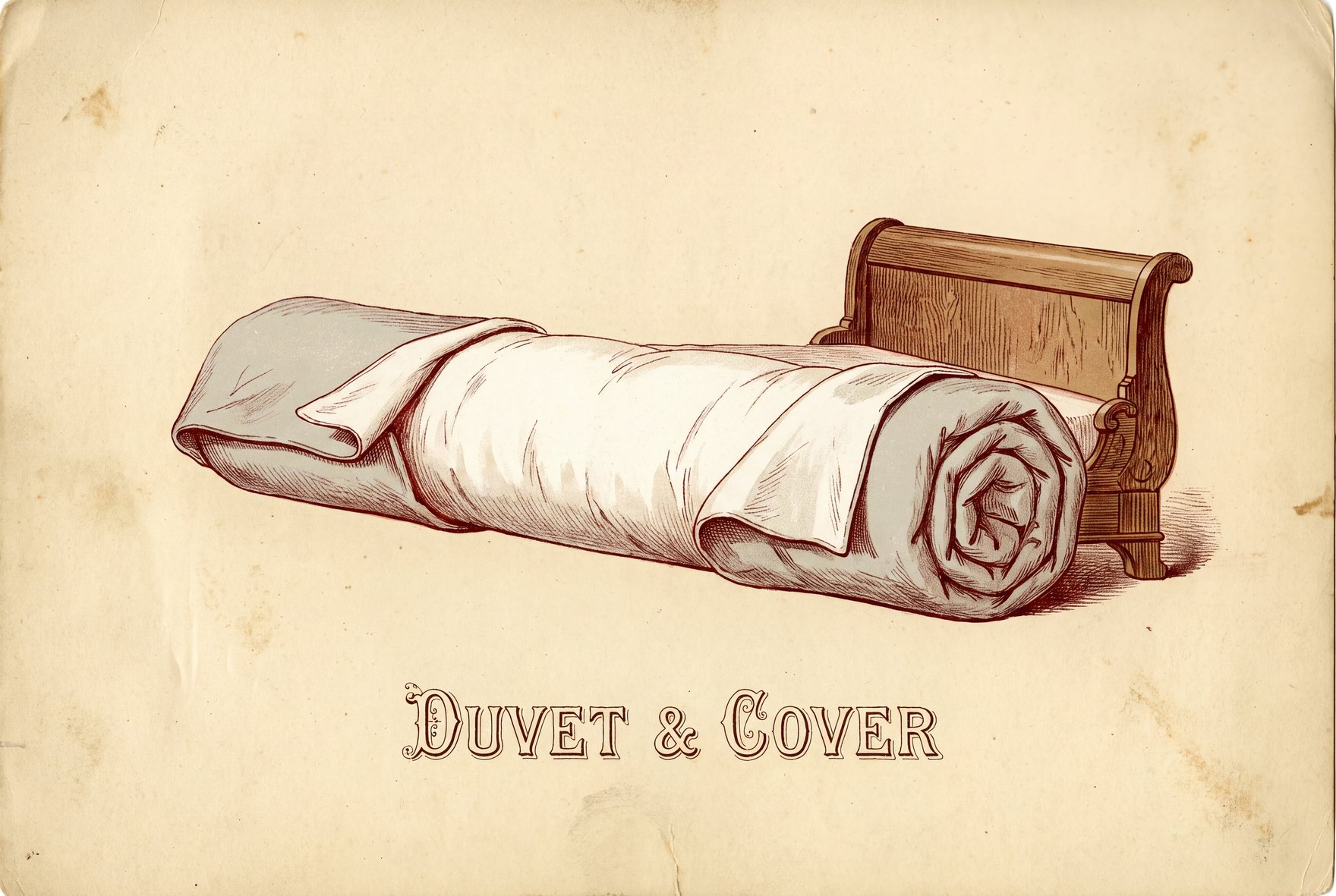
Turn the cover inside out and lay it flat with the opening at the foot. Lay the insert on top, match the corners and tie them. You roll both layers together from the head of the bed toward the foot. Fold the opening back over the ends of the roll, close it, and unroll toward the pillows. One seller says it takes about two minutes solo once you've done it once (Orezon).
Key Takeaways
- We read 12 published sets of roll-method steps. 7 of them tell you to close the cover while it is still rolled.
- Tie all 4 corners before you roll. Cover ties do nothing for you if the insert has no loops, or if you never tie them.
- Match sizes in inches, not size names. Inserts often run up to 2 inches wider and longer than their covers.
Which way should the cover face before you start?
Turn the cover inside out, lay it flat on a clear bed, and put its opening at the foot. Every method on this page starts from that position.
Start with a clear bed. You take off the pillows and any blankets so the whole cover can lie flat. Bare Home lists it first. Then turn the cover inside out so the seams face up.
Put the opening at the foot of the bed. Sleep Foundation and West Elm both start the roll this way. When you finish, the buttons or zipper sit by your feet. That keeps the closure away from your face while you sleep (Parachute).
The reach-in method starts differently. You lay the inside-out cover on top of the insert. Line up the corners and put the opening at the head. The flip then moves the opening to the foot (Parachute). Plumeria Bay gives the same reason for ending there.
One habit saves you a step. A housekeeping guide from the Finnish Institute of Occupational Health advises folding duvet covers inside out so the duvet slips in easily (TTK). If you store a clean cover that way, you can lay it straight down next time.
Last, find the corner ties or loops. You tie them before you roll or flip anything. Keep them within reach.
How does the burrito method work, step by step?
Lay the insert on the inside-out cover, roll both from the head to the foot, wrap the opening around the roll, close it, then unroll the bundle.
The method goes by more than one name. West Elm calls it the sushi roll. Parachute calls it the California roll. This order follows Sleep Foundation and West Elm:
- Lay the cover inside out and flat, with the opening at the foot of the bed.
- Spread the insert on top so each of its corners sits on a cover corner.
- Tie each cover tie to the matching loop on the insert, starting with the corners.
- Starting at the head, roll both layers together tightly as you move toward the foot.
- At the foot, reach into the opening and fold it back over each end of the roll.
- Close the zipper or buttons around the roll while you still have it rolled up.
- Unroll toward the head of the bed, then give the cover a few shakes.
The fold at the foot is where the cover turns right side out. Mattress Miracle compares it to turning a sock. As you unroll, the cover wraps itself around the insert.
Roll tightly and keep the edges lined up. Family Handyman says to stop rolling when you hit the bottom opening. If your roll is loose, the insert creeps back toward the closed end.
Parachute adds one detail. You lay the insert with its corner tabs facing down, so they meet the cover's ties (Parachute).
If your roll comes out twisted, unroll it. Straighten the corners and start again. A small slant at the head end grows with every turn. Fix it early.
How do you do it the traditional way, by reaching inside?
Tie the insert's far corners to the cover, reach in from the opening, grab those corners, and flip the cover right side out over the insert.
The traditional method skips the roll. West Elm lays it out like this: turn the cover inside out, spread the insert on top, and tie each corner. You then reach in from the open end and grab the corners at the closed end. Pull them through so the cover flips over the insert. Then button the opening.
There is a quicker version. West Elm says you can tie only the corners at the closed end and flip the cover over the whole insert.
Most people know the shake method. You grab the top corners of the cover and insert together and shake until the cover slides down. Doze says it works best with light duvets and corner ties. Amerisleep adds that two people and lighter inserts help.
Your arms and back do this work. Let the insert rest on the bed while the cover goes over it, as the Finnish guide tells housekeepers (TTK). Don't hold a full insert up at shoulder height and shake it.
| Method | Where the weight sits | Alone with a heavy insert (our judgement) | Corner ties |
|---|---|---|---|
| Roll (burrito) | On the mattress throughout | The easiest here | Help, not required |
| Reach-in flip | On the bed, then pulled through | Workable if the far corners are tied | Help a lot |
| Shake | Partly in your arms | Hard; easier with two people | Doze says they are needed |
| Three-sided zipper | Flat on the bed | Easy | Snaps or ties hold corners |
How do you close a cover with buttons, a zipper, ties or snaps?
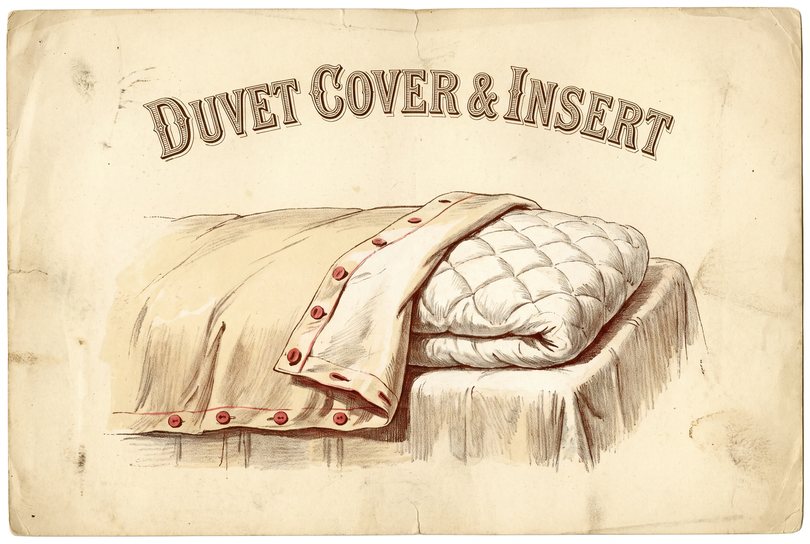
A zipper closes the opening in one pass. Buttons take longer and leave small gaps. Ties and snaps inside the corners hold the insert in place.
The opening and the corner fastenings do different jobs. The opening keeps the insert in. The corner fastenings stop it moving around. Bare Home explains that a zipper seals the open edge in one pass, while buttons leave small gaps and take longer. Buttons do have one plus. You get no zipper tape to snag in the wash. The same page says neither closure stops the insert shifting.
Button counts vary by cover. Plumeria Bay mentions that a row of buttons can be tedious to fasten every time you change the cover. Work from one end to the other. That keeps the edges lined up, and you won't skip a button.
Ties come in pairs. A tie sewn inside each corner of the cover knots to a loop on the insert. California Design Den's queen listing has ties in its interior corners. Bedsure's zipper cover lists corner ties as well.
Some covers open on three sides. Doze's product page says you lay the insert flat, snap the corners and zip it up.
| Closure | How you close it | What it will not do (our reading) |
|---|---|---|
| Zipper | One pull along the opening | Stop the insert shifting |
| Buttons | One at a time, end to end | Close without small gaps |
| Corner ties | Knot each tie to an insert loop | Anything, if the insert has no loops |
| Three-sided zipper | Zip around three edges | Hold corners without snaps or ties |
What do the published instructions say about when to close it?
Most of the published roll-method steps we read say to close the cover while it is still rolled, before you unroll it across the bed.
We read 12 published sets of roll-method instructions on October 17, 2026 and noted at which point each one closes the cover. The table records only what pages state. We did not time or test any method here.
| When the page says to close | Pages | Count |
|---|---|---|
| Before unrolling, around the roll | Sleep Foundation, West Elm, Modern Dane, Linens Delight, Mattress Miracle, Orezon, Bare Home | 7 |
| After unrolling and shaking | Parachute, Pure Parima, Wild Revival | 3 |
| No closing step in the steps we read | Amerisleep, Nateo | 2 |
The pages that close first give a reason. Linens Delight says to button, snap or zip the cover while it is still rolled. That locks everything in place. A closed roll can't come apart while you unroll it.
Closing last has its own advantage. You can shake the insert into the corners and check that it lies flat before you seal it. If a corner keeps slipping, you reach in and fix it. You don't have to open anything.
Both orders end with a covered insert. Close first if your roll keeps coming loose, and close last if you like to check the corners. With many buttons, closing first means you do them up on a narrow roll. That can be easier than leaning over a full bed.
Why does the insert slide into one end, and how do you stop it?
The insert drifts when its corners are loose inside the cover. Tying each cover tie to the matching loop on the insert stops most of it.
Bunching usually comes from loose corners. Bare Home says corner anchors stop the insert from collapsing into one end. The same page says side ties hold the long edges. That is where you will usually see a King or Cal King cover empty first.
Ties only work in pairs. You need a tie on the cover and a loop on the insert. Some inserts have both kinds. Better Homes & Gardens' full/queen insert lists corner and side loops for this job.
No loops on your insert? You can still use the ties. Modern Dane says you can simply tie around each corner of the duvet. If your cover has no ties, Snowe suggests duvet clips that fasten the insert's corners to the cover's corners.
Size matters here too. Bedsure's sizing guide warns that a cover a couple of inches wider than the insert gives the fill room to drift (Bedsure). Ties help. They can't make up for a cover that is too big.
Tie the knots firmly, but leave yourself a way to undo them. A bow comes undone in the wash. A double knot holds better, but you have to untie it at every change.
Does the size of the insert change how it goes in?
Match the insert to the cover in inches, not by the size name. An insert that is the same size or slightly larger fills the corners.
Size names are not standard. Bedsure says a queen duvet cover comes in several sizes depending on the brand (Bedsure). Two pieces you bought as Queen may still not match. Measure both before you blame your technique.
Purple's chart shows how the queen pieces usually compare (Purple):
| Pairing | What the sources say | Effect on putting it on (our judgement) |
|---|---|---|
| Insert slightly larger than the cover | Within Purple's queen ranges | Fills the corners; you need a tighter roll |
| Insert and cover the same size | Also within Purple's ranges | Goes on smoothly |
| Insert far larger than the cover | Wellwhisk warns against it | Bunches, and the zipper may not close |
A slightly larger insert fills the corners, which also makes them easier to line up when you lay the pieces flat. Roll a little tighter. That way the opening still reaches around the roll.
A much larger insert causes trouble. Wellwhisk says an insert more than 4 inches larger than the cover will create bunching and uneven warmth (Wellwhisk). Another seller warns that forcing a much larger insert into a smaller cover can strain the seams and zipper (Lili Alessandra). For you, a cover that fits closes without a fight and spares its seams.
If the zipper won't close, measure the insert. A gap of more than a few inches is not something you can fix with technique. The mismatch is why it keeps fighting you.
How long does it take, and why is a heavy insert harder?
Sellers say the roll takes a few minutes once you learn it. A heavy insert is harder because you lift and shake more weight.
All these times come from sellers. None come from independent timing. Amerisleep says the roll takes most people under three minutes. Mattress Miracle says you get faster after a few tries. For its three-sided cover, Doze says you can be done in under a minute.
Weight is what makes it hard. A US patent for a bed-making aid notes that hotels are moving to oversized bedding with heavy duvets. It adds that two people are often needed to cover a comforter when the bedding is oversized. For you, a heavy insert is the one to roll, so the mattress carries the weight instead of your arms.
Bending is the other problem. Researchers watched housekeeping staff at an Amsterdam hotel use a duvet-changing tool. They said the improvement came mainly from a new posture that needed less bending (Journal of Qualitative Research in Tourism). A peer-reviewed survey of hotel housekeepers lists making beds among the tasks that need awkward postures. The California Code of Regulations has a section meant to control the risk of musculoskeletal injuries to hotel housekeepers.
The same idea works at home. Keep the weight on the mattress, and work from the side of the bed rather than leaning across it. Use the roll for heavy inserts. Other guides on the assembly hub cover the rest of making the bed.
Common questions
Short answers to the questions people ask most often after the main steps, from missing ties to which end of the bed the opening goes.
Which end of the bed should the opening go at?
Put it at the foot. You set it up that way for the roll, and the closure ends up away from your face. Some people like the opening at the head for looks. Parachute says either is fine (Parachute). Both methods are easiest when you finish with the opening at the foot.
What if the cover has no corner ties?
Line up the corners as closely as you can before you roll. Mattress Miracle gives the same advice for covers without ties (Mattress Miracle). Duvet clips are the add-on fix. You can also buy an insert with loops if you want something that lasts.
Is it easier with two people?
For the shake method, yes. Each of you holds one side, and the insert stays off the floor. The roll is designed for one person. Mattress Miracle says it works solo on any size duvet, from twin to king. With an oversized hotel insert, a second pair of hands still helps you.
Should you store the cover inside out?
It saves you a step next time. The Finnish occupational health guide tells housekeepers to fold covers inside out so the duvet slips in easily (TTK). One home writer also turns covers inside out and closes them before washing, so they don't tangle (Wild Revival). Our guide on washing linen sheets covers the wash itself.
Do you still need a sheet under the duvet cover?
That depends on how often you plan to wash the cover. Many people sleep straight under the cover and wash it with their sheets. Some add a flat sheet so they can change the cover less often. Our guide to the top sheet covers that question.
Why won't the zipper close around the roll?
Your roll is probably too loose. Or the insert is too big for the cover. Unroll it and roll again more tightly. Keep the edges lined up as you go. If it still won't close, compare the sizes in inches. Wellwhisk warns that a much larger insert leads to bunching (Wellwhisk).
Sources
Top Sheet's references for this piece, set out in citation order with the heading each one sits under.
- California DIR filing, 2012 (dir.ca.gov), sits under the standfirst.
- Orezon (orezon.co), sits under “What do the published instructions say about when to close it?”.
- Bare Home (barehome.com), sits under “Which way should the cover face before you start?”; “How do you close a cover with buttons, a zipper, ties or snaps?”; “What do the published instructions say about when to close it?”; “Why does the insert slide into one end, and how do you stop it?”.
- Sleep Foundation (sleepfoundation.org), sits under “Which way should the cover face before you start?”; “How does the burrito method work, step by step?”; “What do the published instructions say about when to close it?”.
- West Elm (westelm.com), sits under “Which way should the cover face before you start?”; “How does the burrito method work, step by step?”; “How do you do it the traditional way, by reaching inside?”; “What do the published instructions say about when to close it?”.
- Parachute (parachutehome.com), sits under “Which way should the cover face before you start?”; “How does the burrito method work, step by step?”; “What do the published instructions say about when to close it?”; “Common questions”.
- Plumeria Bay (plumeriabay.com), sits under “Which way should the cover face before you start?”; “How do you close a cover with buttons, a zipper, ties or snaps?”.
- TTK (ttk.fi), sits under “Which way should the cover face before you start?”; “How do you do it the traditional way, by reaching inside?”; “Common questions”.
- Mattress Miracle (mattressmiracle.ca), sits under “How does the burrito method work, step by step?”; “What do the published instructions say about when to close it?”; “How long does it take, and why is a heavy insert harder?”; “Common questions”.
- Family Handyman (familyhandyman.com), sits under “How does the burrito method work, step by step?”.
- Doze (dozebedding.com), sits under “How do you do it the traditional way, by reaching inside?”.
- Amerisleep (amerisleep.com), sits under “How do you do it the traditional way, by reaching inside?”; “What do the published instructions say about when to close it?”; “How long does it take, and why is a heavy insert harder?”.
- California Design Den's (amazon.com), sits under “How do you close a cover with buttons, a zipper, ties or snaps?”.
- Bedsure's (amazon.com), sits under “How do you close a cover with buttons, a zipper, ties or snaps?”.
- Doze's (dozebedding.com), sits under “How do you close a cover with buttons, a zipper, ties or snaps?”; “How long does it take, and why is a heavy insert harder?”.
- Modern Dane (moderndane.com), sits under “What do the published instructions say about when to close it?”; “Why does the insert slide into one end, and how do you stop it?”.
- Linens Delight (linensdelight.com), sits under “What do the published instructions say about when to close it?”.
- Pure Parima (pureparima.com), sits under “What do the published instructions say about when to close it?”.
- Wild Revival (wildrevivalgardening.com), sits under “What do the published instructions say about when to close it?”; “Common questions”.
- Nateo (nateoconcept.com), sits under “What do the published instructions say about when to close it?”.
- Better Homes & Gardens' (walmart.com), sits under “Why does the insert slide into one end, and how do you stop it?”.
- Snowe (snowehome.com), sits under “Why does the insert slide into one end, and how do you stop it?”.
- Bedsure (bedsurehome.com), sits under “Why does the insert slide into one end, and how do you stop it?”; “Does the size of the insert change how it goes in?”.
- Purple (purple.com), sits under “Does the size of the insert change how it goes in?”.
- Wellwhisk (wellwhisk.com), sits under “Does the size of the insert change how it goes in?”; “Common questions”.
- Lili Alessandra (lilialessandra.com), sits under “Does the size of the insert change how it goes in?”.
- US patent for a bed-making aid (image-ppubs.uspto.gov), sits under “How long does it take, and why is a heavy insert harder?”.
- Journal of Qualitative Research in Tourism (elgaronline.com), sits under “How long does it take, and why is a heavy insert harder?”.
- peer-reviewed survey of hotel housekeepers (pmc.ncbi.nlm.nih.gov), sits under “How long does it take, and why is a heavy insert harder?”.
- California Code of Regulations (law.cornell.edu), sits under “How long does it take, and why is a heavy insert harder?”.