What is a top sheet?
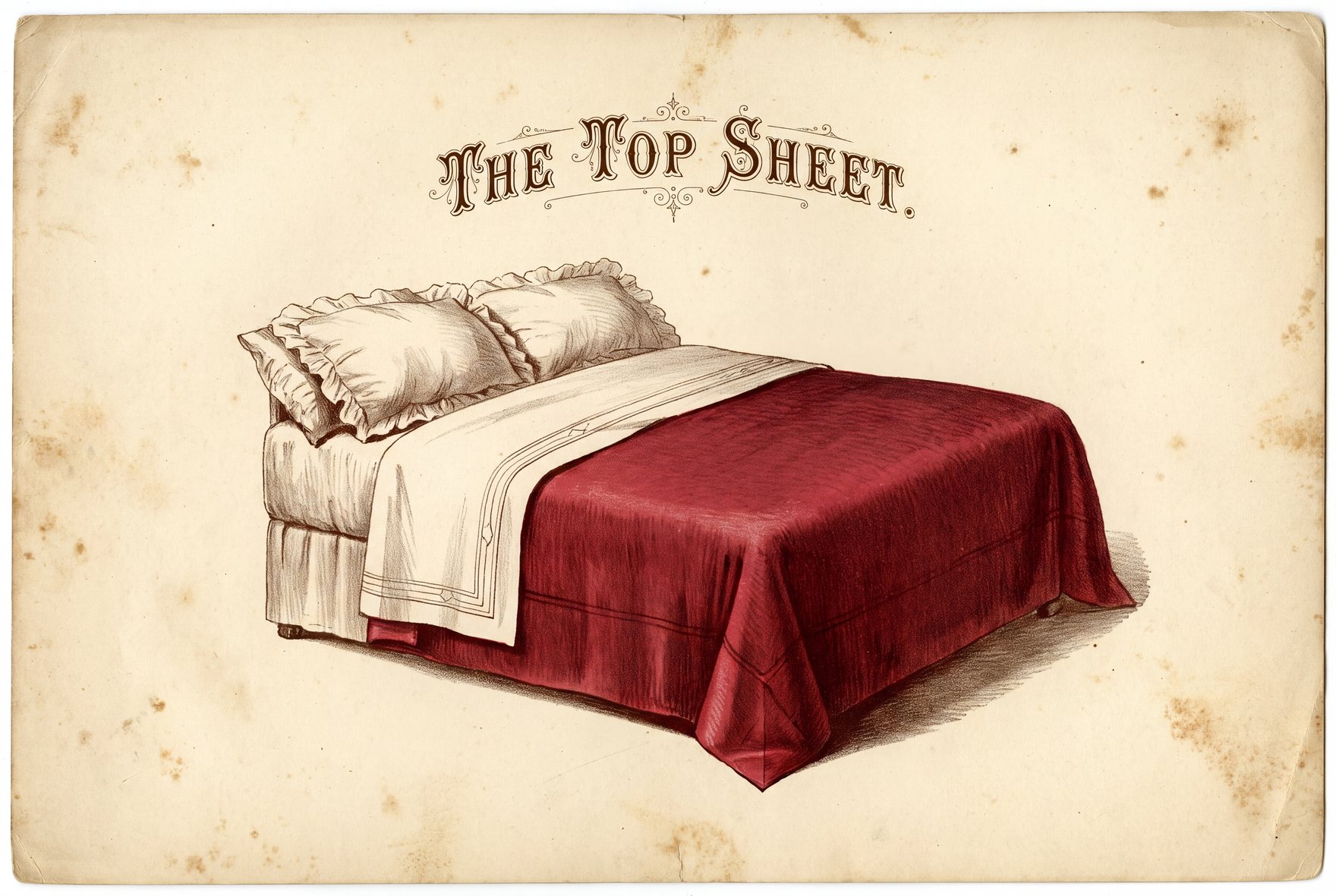
A top sheet is the flat sheet you sleep under. This page covers what it does, which size fits your mattress, and how to put one on so it stays tucked.
Short answer: A top sheet is a plain rectangle of fabric with no elastic. It lies between you and your blanket or comforter. "Top sheet" names where it goes and "flat sheet" names its shape, so both names mean one sheet. It keeps heavier bedding clean. A sheet is far easier to wash each week than a comforter. A standard queen flat sheet is 90 by 102 inches (American Textile), and you tuck it under the foot of the mattress.
This guide is for: people setting up a bed with a flat sheet the first time, or deciding whether to keep using one.
Key Takeaways
These facts answer most of what people search for here: what the sheet is, which size to buy, and how hot to wash it each week.
- A top sheet is a flat sheet with no elastic, used as the layer you sleep under. Most adults still use one. In a 2018 poll, 79% of people aged 55 and up said they always or often use a top sheet (YouGov, 2018).
- A standard queen flat sheet is 90 by 102 inches (American Textile). Sellers often cut wider, though. Of the 12 seller pages we read, 6 list a queen flat sheet at 96 inches wide or more, which matters on a deep mattress.
- Wash it weekly, and use heat if you can. In a laboratory laundry study of cotton sheets, a 140°F (60°C) wash left no live dust mites (ScienceDaily, 2007). A hot dryer cycle is the fallback.
On This Page
These questions, in the order most people ask them, from what the sheet is to how to tuck its corners and how often to wash it.
What is a top sheet, and is it the same as a flat sheet?
Yes. A top sheet is a flat sheet: a hemmed rectangle of fabric with no elastic that lies over you and under your blanket or comforter.
The two names describe one piece of cloth. "Flat sheet" names the shape, and "top sheet" names the job. Its partner is the fitted sheet. That one has elastic corners that grip your mattress. You lie on it, not under it.
| Piece | Shape | Where it goes | What it protects |
|---|---|---|---|
| Flat (top) sheet | Hemmed rectangle, no elastic | Over you, under the blanket | Your blanket or comforter |
| Fitted (bottom) sheet | Elastic corner pockets | Over the mattress, under you | The mattress |
| Duvet cover | Closed bag with an opening | Around the comforter insert | The comforter insert |
You can still put a flat sheet on the bottom. Nursing texts teach both ways. A flat bottom sheet is positioned evenly on the bed with its corners mitered, while a fitted sheet goes onto the lower edges of the mattress first (Brookside Press, Nursing Fundamentals I). Check the label on a sheet set. If it lists a flat sheet, that piece is your top sheet. You do not need to buy one separately. The exception is when you want a different size or fabric.
Which one should you reach for first? If you are making a bed from bare mattress, start with the fitted sheet. The flat sheet goes on after it, printed side down, and the steps further down this page walk you through it.
What does a top sheet do for you?
It keeps your blanket or comforter clean, gives you one light layer that washes easily, and lets you sleep cooler on warm nights.
A top sheet is a washable barrier. Your skin, sweat and body oils land on whatever touches you all night. A top sheet keeps that layer thin. It goes in the wash with your fitted sheet. Without one, the comforter takes that job, and comforters are bulky and slow to dry. Some will not fit a home washer.
Each layer has its own job. Health agencies say something similar about the layer below you: a county health department advises using fitted sheets to reduce the buildup of human skin on the mattress surface (Macomb County Health Department). Your top sheet does that job for the bedding above you.
It also helps with temperature. On a hot night you can sleep under the sheet alone and push the blanket to the foot. In cold months, fold the sheet back over the blanket's edge. Nursing notes call this fold a cuff and say it protects the skin from irritation caused by the blanket (SaralMind nursing notes). That matters if you sleep under wool.
The cost is effort. You have one more piece to straighten each morning and one more to fold on laundry day. Does yours always end up knotted at your feet? The fix is usually a firmer tuck at the foot, covered below.
How many people still use a top sheet?
Most adults still do, but the habit is strongest among older people and weakest among people in their late teens and early twenties.
The clearest public figures come from a national poll. It followed a viral tweet claiming that millennials don't use top sheets. In the YouGov survey, a large majority of the oldest adults said they always or often use a top sheet. Among the youngest adults, only about half did.
So the habit is fading, not vanishing. Even in the youngest group, about half still use one. Men and women answered almost alike. Regions of the US barely differed either. Age is the one split that stands out in the answers.
Keep the date in mind. The poll is several years old, and habits may have moved since. We found no newer national survey of this question in our research.
What should you take from it? There is no social rule here. Both choices work if the layer touching you gets washed often. If you skip the sheet, a duvet cover you wash weekly keeps your comforter clean too. If you keep it, you get a crisp layer and a lighter laundry load. The one setup that fails is skipping the sheet and rarely washing the comforter. You can see when each choice makes sense in the duvet cover section below.
What size flat sheet fits your bed?
Buy the flat sheet labeled for your mattress size, then check its width against your mattress depth, since deep mattresses need more.
You buy flat sheets by bed size, not by exact fit. A US linen supplier's size chart lists these flat sheet dimensions (American Textile):
| Bed size | Flat sheet, width × length |
|---|---|
| Twin and Twin XL | 66 × 96 in |
| Full | 81 × 96 in |
| Queen | 90 × 102 in |
| King and California King | 108 × 102 in |
Treat these as floors, not fixed sizes. Another seller calls that queen size the typical standard minimum for a queen flat sheet (American Blossom Linens). Many sellers cut larger.
Width decides whether the sheet will tuck. The sheet has to cover the top of your mattress. It drops down both sides. Then it still needs fabric left over to fold under. A seller notes that its queen flat sheet is a good deal wider than the queen mattress it goes on (Bedgear). On a thin mattress, that is plenty. On a thick pillow-top, the sides use up most of it.
So measure your mattress depth before you buy. Is it deep? Then look for a listing a few inches wider than standard. Our flat sheet guide covers fabric and fit in more detail. The king size flat sheet page covers the largest beds.
How wide are the queen flat sheets sellers list?
Often wider than the standard chart suggests. Half the seller pages we read list a queen flat sheet well over the minimum width.
Our count: On September 26, 2026, we read 12 published size charts and product pages from US bedding sellers. We noted the queen flat sheet width each one states. We did not weigh or measure any sheet. The table records only what the pages say.
| Stated queen flat sheet width | Pages | Which pages |
|---|---|---|
| 96 inches or wider | 6 | Casper, DreamCloud, Bedgear, QuickZip, Southshore Fine Linens, Saatva |
| At least 90 inches but narrower than 96 | 5 | American Textile, The Company Store, Brooklinen, Qbedding, Beddley |
| A range, not one width | 1 | Vaya |
The spread is wide. One page skips a single figure. It gives you a span of widths instead.
The word "queen" does not fix the width. On a queen mattress, the wider sheets give you a deeper tuck on each side. On a deep mattress, those extra inches can be the whole tuck. When you shop, read the listed dimensions, not only the size name. Is a listing missing its dimensions? Take that as a reason to look elsewhere.
How do you put a flat sheet on a bed?
Fitted sheet first, then the flat sheet printed side down with its wide hem at the head, centered, and tucked firmly under the foot.
Start with the bottom layer and work up. These steps make a standard home bed. Mitered corners, the tidy folded kind, come in the next section.
- Put the fitted sheet on first. Seams should face the mattress, away from the sleeper (Nursing Assistant, WTCS Pressbooks).
- Lay the flat sheet printed side down. When you fold the top back later, the good side shows. Nursing notes place the top sheet wrong side up, with the wider hem at the head and the center fold along the middle of the bed (RNpedia).
- Line up the top hem with the head of the mattress. Then check that both sides hang evenly.
- Tuck the foot under the mattress. Lift the mattress corner and push the fabric well under, not just past the edge.
- Decide on the sides. Tuck them for a snug bed, or leave them loose if you turn a lot at night.
- Add the blanket or comforter. Fold the top of the sheet back over its edge.
Your foot tuck does most of the work. A sheet held only at the foot stays put and still leaves you room to turn over. Does yours keep pulling free? It is probably too short or tucked too shallowly. A deeper foot tuck fixes most cases. Going up a size fixes the rest.
How do you make a hospital corner with a flat sheet?
Tuck the foot end under, lift the side edge into a diagonal fold, tuck the part still hanging, then drop the fold back over the side.
A hospital corner, also called a mitered corner, holds a flat sheet tight without elastic. You know it as the neat diagonal crease on a well-made bed. Nursing-assistant training teaches it as a short sequence (Nursing Assistant, WTCS Pressbooks):
- Push the whole end of the sheet under the foot of the bed.
- Face the foot of the bed and lift the side edge so the sheet makes a 45-degree angle from the corner.
- Lay that angled flap on top of the bed and tuck in whatever hangs below the frame.
- Lower the angled flap back over the edge of the bed.
Repeat on the other side. For a top sheet, miter only the two foot corners. Leave the head free so you can get in. Nursing notes tuck the foot of the top sheet, miter the corner, and leave the side free (RNpedia).
Add one comfort tweak. Nursing-assistant training also teaches a toe pleat, a pleat in the sheet that lets the feet move and prevents pressure. Pinch a fold a few inches deep across the sheet near the foot. Then tuck. A toe pleat stops a tight sheet from pressing your toes down all night. It takes you seconds.
Do you need a top sheet if you have a duvet cover?
Not always. A duvet cover you wash as often as your sheets keeps the comforter clean; if you wash it less often, a top sheet is easier.
A duvet cover and a top sheet both keep your skin off the comforter. The deciding question is which layer you will wash every week. A sheet is light and quick. A duvet cover means stripping it, washing it, and wrestling the insert back in. If that chore means your cover gets washed monthly, a top sheet under it keeps things cleaner.
The table below is our judgement. It rests on how each setup gets used. No maker publishes it.
| Your setup | Top sheet? | Reason |
|---|---|---|
| Comforter with no cover | Yes | The sheet is the only washable layer between you and it |
| Duvet cover washed weekly | Optional | The cover already keeps the comforter clean |
| Duvet cover washed monthly or less | Yes | A sheet is easier to wash each week |
| Hot sleeper in summer | Yes | The sheet can be your only cover |
| Wool or scratchy blanket | Yes | It keeps the fiber off your skin |
| You kick covers loose | Try a firm foot tuck first | A loose sheet ends up bunched at your feet |
If you share a bed, you can split the difference. One person sleeps under sheet and duvet. The other uses the duvet alone. Our guide on whether you need a top sheet walks you through that choice. It also covers sizing a flat sheet to your bed.
How often should you wash a top sheet?
Once a week is the common medical advice, in the hottest water your washer offers, or with a hot dryer cycle if your water runs cooler.
Mayo Clinic health information, republished by Mosaic Life Care, says to wash all sheets weekly in water of at least 130°F to clear dust mites and allergens. Can't wash hot? It suggests a spell in a dryer running above that heat.
Lab work backs up the heat. In a study of cotton sheets, a hot wash left no live dust mites, while warm water left most of them alive (ScienceDaily). An older peer-reviewed laundry study found the same pattern: hot water killed every mite, while a cold wash did not remove most live mites from bedding (Journal of Allergy and Clinical Immunology, via PubMed). So heat does the heavy lifting. The researchers in the newer study also found a gentler route for sheets that can't take heat. You wash at a lower temperature, then rinse twice in cold water.
Watch the tap, too. Hot water from a home heater can scald. The practical answer is to leave your water heater alone. Use the hottest cycle your care label allows. Then run a hot dryer.
A top sheet makes this routine easier. It goes into one load with your fitted sheet and pillowcases. If you skip it, put your duvet cover in that weekly load instead. Nursing guidance sets a weekly floor as well: change linens at least weekly, or whenever they are soiled (Medicine LibreTexts). Pick one wash day and keep it.
Common questions
Short answers to the questions that come up after the main ones, from which side faces up to whether a queen sheet fits a full bed.
Is a top sheet the same as a flat sheet?
Yes. "Flat sheet" describes the shape and "top sheet" describes the position. Any flat sheet you sleep under is a top sheet. A flat sheet you lie on is a bottom sheet.
Which side of a flat sheet faces up?
Put the printed or smoother side down. When you fold the top edge back over the blanket, that side shows. The wider hem goes at the head of the bed.
Can a flat sheet replace a fitted sheet?
It can. Center it, tuck the head and foot under, and miter all four corners. Nursing texts still teach this method. Expect to re-tuck it more often than elastic corners.
Can you use a queen flat sheet on a full bed?
Usually, yes. The extra width tucks under. Charts disagree on full sizes: one lists a full flat sheet narrower than its queen (American Textile), while another says the full flat sheet matches the queen (Casper).
Why does my top sheet end up at the foot of the bed?
It is too short. Or it is not tucked deep enough at the foot. Push the foot end well under the mattress and add hospital corners. A sheet one size up gives you more to tuck.
What is a toe pleat?
It is a small fold across the top sheet near the foot. It leaves room for your feet. A tight tuck then won't press your toes down. Make it before you tuck the foot end.